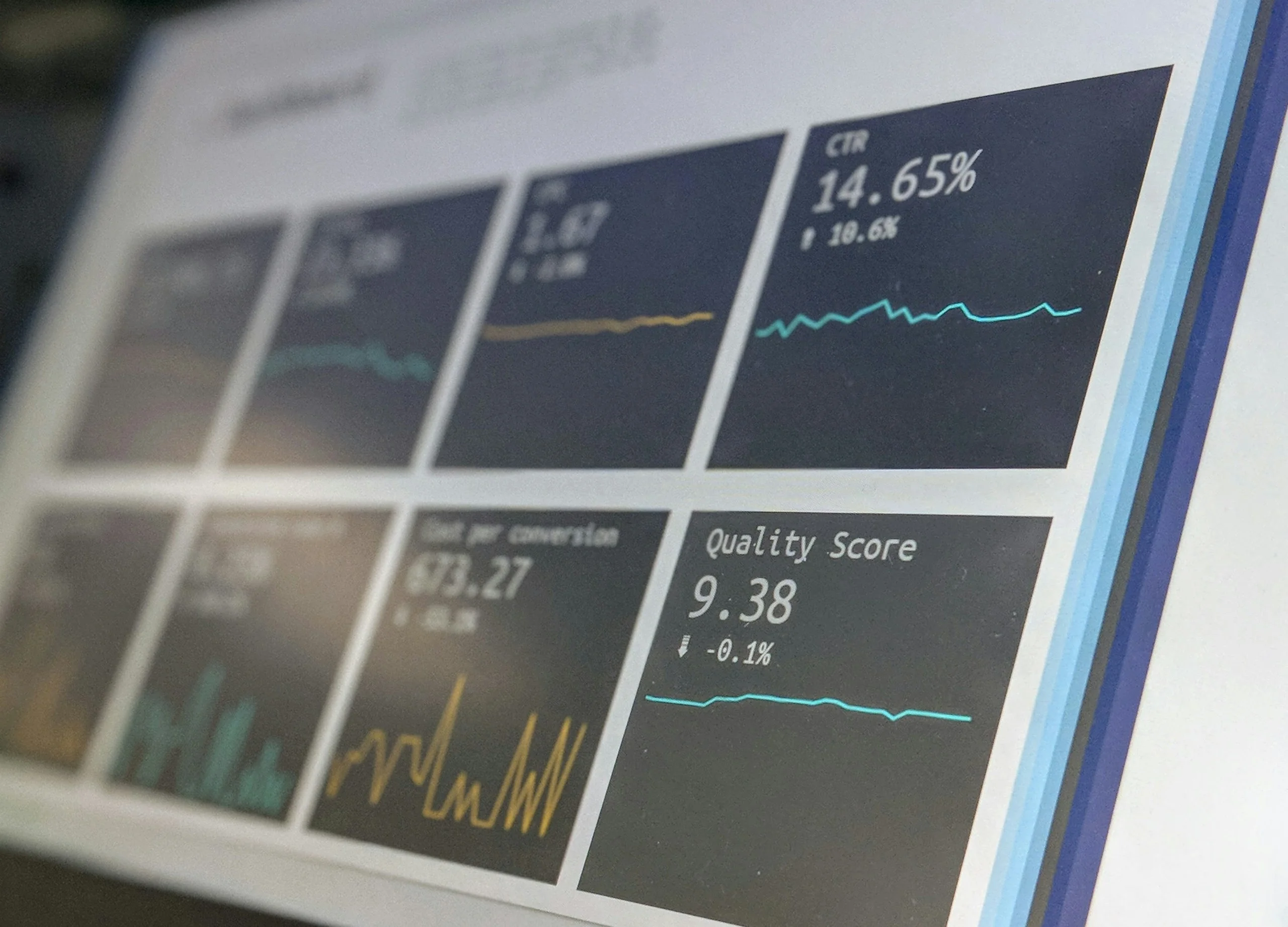
You spend hours generating article ideas, hunting down every keyword on Google Ads, and feverishly watching for green lights in your SEO. You sincerely believe that traffic volume will save your business. That is an illusion: without a CRO strategy, this traffic does not turn into customers.
On Google Analytics, you watch your curves climb. Perhaps you are even trying to generate new revenue streams through new tools or semantic analysis. And then? Nothing. Visitors leave as fast as they arrived. Your website suffers from invisible friction and loses major conversion opportunities. The most beautiful site in the world is completely useless if it acquires no customers through this channel and if it is poorly optimised for search. You treat your platform as a static display when every point of friction destroys your profitability in real time.
CRO (Conversion Rate Optimization) means increasing the share of visitors who take the expected action on your site: request a quote, book, buy, sign up. It is neither a magic formula nor a technical setting you install once and for all, but ongoing work: observe, form a hypothesis, make a change, measure.
Let us set aside the empty promises of passive technology. To turn that traffic into real customers over time, you need structure, method and watertight logic. This is where the step-by-step analysis begins.
At Smart Impact, we have noticed that successful optimisation always rests on a fine understanding of the user experience, supported by intelligent tools. The idea is simple: simplify complexity in order to turn it into an opportunity for growth.
A customer journey that fits: the basis of optimisation
To plug the leaks on your site, the first essential step is to adapt your users’ journey rigorously. An effective website must capture visitors’ attention immediately, hold it, then invite them smoothly and quickly to take action or get in touch. On a landing page, this logic tightens further (one page, one offer, one action), as we show in our landing page guide.
- Relevance of the information: the essential information has to be reachable, clear and perfectly relevant to ordinary people, not only to you.
- Technical performance: the technical characteristics have to be monitored daily; pages that load too slowly or read badly on a phone seriously harm your overall performance.
- Continuous improvement: it is essential to gather objective reviews and feedback (from clients or people close to you) so you can keep refining and adapting the layout of your home page and all your web pages.
Semantic analysis and automation: intelligence in the service of conversion
Delivering personalised experiences in real time is a real challenge for digital marketing specialists. That is exactly where the intelligence of modern tools comes in, not to replace human thinking, but to automate engagement at key moments.
The secret lies in setting up platforms able to analyse data in order to trigger highly targeted marketing scenarios instead of static records:
- Instant segmentation: by measuring precise indicators such as Net Promoter Score (NPS), Customer Effort Score (CES) or Customer Satisfaction Score (CSAT), you can segment your customer base and send each group perfectly tailored messages.
- Dynamic scenarios: instead of showing a plain standard thank-you page after an order, you can trigger personalised marketing campaigns, such as referral offers for promoter profiles, or immediate callback requests to limit lost revenue.
- Collecting at key touchpoints: gathering feedback at every stage of the funnel (online purchase, delivery, returns) brings out problems specific to one precise touchpoint, such as unsuitable payment or shipping options.
Where AI fits concretely into a CRO strategy
AI does not replace the method, it speeds up its longest steps. We find it useful in four places.
- Understanding sessions without watching them all: Microsoft Clarity, a free session recording and heatmap tool, includes an assistant (Copilot) that summarises in plain language a recording, a group of sessions or the heatmaps of a page. The abandoned form or the button nobody sees is spotted faster. Microsoft notes that these summaries can contain errors: they direct your attention, but they do not replace watching a few sessions.
- Anticipating behaviour: Google Analytics 4 calculates predictive metrics, such as the probability that a visitor will buy within seven days or will not return. They require a minimum volume, at least 1000 users who triggered the condition and 1000 who did not, which many SME sites in French-speaking Switzerland do not reach.
- Drafting variants to test: a language model proposes several titles, hooks or button labels within minutes. The selection remains human: a variant is only worth using if it stays accurate and true to your tone.
- Testing properly: Google Optimize has no longer existed since 30 September 2023. For A/B tests, Google points to third-party tools connected to GA4, including AB Tasty, Optimizely and VWO. On a low-traffic site, a test can take a long time to separate two versions: we then start by fixing the obvious friction before testing nuances.
Building trust to validate the purchase
Every acquisition strategy is pointless if you fail to build the sense of trust that any sale requires. Conversion rate optimisation necessarily goes through proof of transparency and honesty towards your audience.
Displaying real customer reviews, whether positive or negative, strengthens your brand's credibility and encourages engagement. Indeed, showing clear ratings and satisfaction scores on your e-commerce pages can significantly increase a visitor's likelihood of buying.
By replying quickly to messages and putting proactive support in place to resolve dissatisfaction, you stand out from the competition while building a positive image that supports your sales.
Bringing your conversion under control
A logical journey, a few well-chosen automated scenarios and AI tools used to observe and test faster make it possible to get more from each visit. Accumulating traffic without working on what happens next is not enough.
To make your business sustainable on the Swiss market, make sure you install and regularly monitor your indicators using essential tools such as Google Analytics and Search Console, so you can adjust your priority changes daily and efficiently.