
Commerce enablement refers to all the tools, services and processes that make a company’s online selling possible: the platform that presents the catalogue, payment, logistics, product data, customer service and measurement. The term comes from the English verb “to enable”, meaning to make possible, and Shopify, in a guide published in March 2026, sums it up as providing the technologies and systems needed to run an online business.
Our position can be put in a few words: for an SME in French-speaking Switzerland, the label matters little, but the assembly matters a great deal. A well-designed shop that does not offer TWINT, that reveals shipping costs on the last screen or that cannot say where a parcel is loses the buyer at the very moment they were about to pay. Commerce enablement is the work of choosing each of these building blocks for the Swiss market, then checking that they communicate with one another.
Commerce enablement, e-commerce and sales enablement: three distinct notions
The three terms circulate in the same sales presentations, and slipping from one to the other often muddles discussions. Let us start with e-commerce. The OECD defines an e-commerce transaction as the sale or purchase of a good or service conducted over computer networks by methods specifically designed for the purpose of receiving or placing orders. It specifies that payment and delivery do not have to take place online: an order placed on a website and settled by invoice is still e-commerce, whereas an order sent by a manually typed email is not.
E-commerce, in other words, is the transaction. Commerce enablement is everything that must be put in place for that transaction to take place, be paid, delivered and measured. The difference is not theoretical. Two shops can sell the same products at the same price without offering the same experience, because one takes payment by TWINT and ships the next day, while the other accepts only cards and leaves the customer without news for a week.
Sales enablement is another matter. Salesforce describes it as the use of content, coaching, training and technology to help sales staff get started in their role, develop and sell. It is therefore aimed at the internal sales team, not at the buyer ordering on a website. An accounting firm in Neuchâtel that trains its advisers to present a new service is doing sales enablement; a winery in Lavaux that opens an online shop with TWINT payment and shipping by Swiss Post is doing commerce enablement.
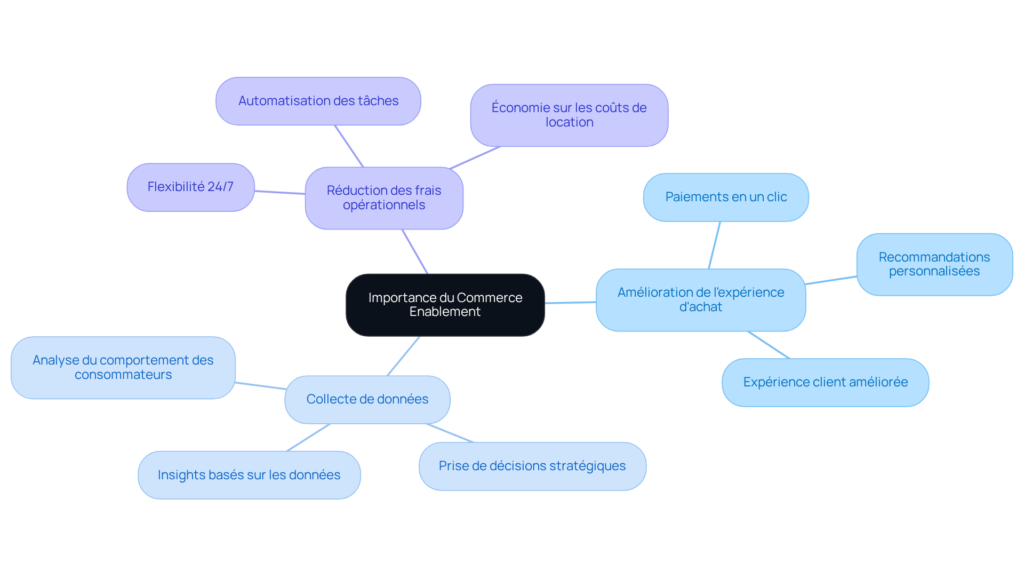
Why commerce enablement matters to SMEs in French-speaking Switzerland too
The Swiss online shopping market is no longer marginal. According to the study published on 12 March 2026 by the commerce.swiss association (Handelsverband.swiss) with the institute NIQ/GfK and Swiss Post, Swiss consumers bought CHF 15.8 billion of goods online in 2025, up from CHF 14.9 billion the previous year, a rise of 6%. Of this total, CHF 13 billion went to Swiss retailers and CHF 2.8 billion to foreign retailers, a line that grew by 8% after an 18% rise in 2024.
The same study notes that nearly half of the country’s top thirty online retailers are marketplaces, with Digitec Galaxus leading the winners. For an SME, competition is therefore not played out on the product alone. It is played out on ease of payment, clarity of costs and reliability of delivery, which are precisely the building blocks of commerce enablement, and which the large platforms industrialised long ago.
This does not mean that a shop in Sion or Fribourg must imitate Galaxus. It has its own cards to play: proximity, advice, detailed knowledge of the product. But the infrastructure must not spoil them at the moment of ordering.
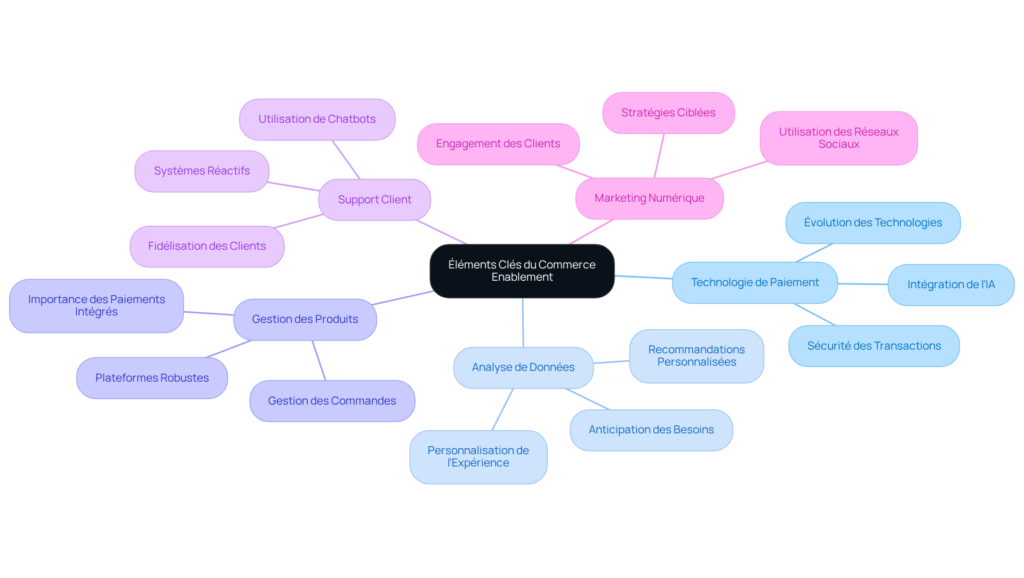
The six components of commerce enablement
In its guide, Shopify lists the platform, order management, payment processing, inventory management, shipping software and customer relationship management. We prefer a slightly different split into six building blocks, closer to the questions an SME in French-speaking Switzerland actually asks itself before opening a shop.
The sales platform
This is the most visible building block, and often the one we spend too much time on. Shopify, WooCommerce or a custom build: the right choice depends less on the feature list than on the tool’s ability to plug into everything else, namely Swiss payment methods, accounting software, the carrier and the measurement tool. A platform that forces you to re-enter each order in the accounts will cost more in use than its subscription suggests. For a shop aimed at the whole of Switzerland, handling French and German is also part of the specification from the start.
Payment: TWINT, cards, invoice and displayed prices
This is where most avoidable sales are lost. TWINT reports 901 million transactions in 2025 and more than 6 million people regularly using the app; according to the company, more than 84% of online shops in Switzerland accept it. The Swiss Payment Monitor 2026 from the University of St Gallen and ZHAW, based on a survey conducted in November 2025, confirms this position. In distance purchases, TWINT accounts for 67% of mobile payments by number of transactions, and mobile payment represents 45.2% of revenue, ahead of credit card (22.8%) and invoice (22.2%). The authors themselves note that these shares vary strongly from one edition to the next, because a few large amounts are enough to shift them.
The same survey adds a useful nuance. With a well-known Swiss retailer and for a small amount, 52.4% of respondents choose TWINT, against 9% for invoice. As the amount rises, preference shifts towards credit card and invoice, seen as safer: with an unknown foreign retailer, for a purchase of 1’000 euros, 48.5% of respondents opt for invoice. For an SME selling modest baskets, TWINT and card cover most needs. For an SME selling furniture, professional equipment or items costing several hundred francs, invoice deserves thought, provided you know who bears the risk of non-payment. Since the red and orange payment slips have no longer been processed by financial institutions since the end of September 2022, an invoice issued today goes through the QR-bill or eBill.
Payment also includes what is displayed before paying. SECO, in its FAQ on the Price Indication Ordinance, states that an online shop addressing Swiss customers must at all times show the price actually payable in Swiss francs, VAT included, and that delivery costs must be communicated separately, clearly and prominently. On VAT, the Federal Tax Administration has applied since 1 January 2024 a standard rate of 8.1% and a reduced rate of 2.6%, and VAT registration is required from CHF 100’000.- of annual revenue. Special cases, notably sales abroad, should be validated with your accountant.
Logistics and returns
A sale is only complete when the parcel has arrived and the customer has not had to call to find out where it was. In Switzerland, Swiss Post states that a PostPac Priority parcel is delivered on the next working day, with Saturday delivery remaining a paid option. The choice of carrier nevertheless matters less than the consistency of the promise: the delivery time announced on the product page must match what the warehouse, or the back room, can actually keep on a Monday in December.
Returns belong to the same building block. A simple returns policy, written in black and white, reassures before purchase, and a return label prepared in advance avoids a string of pointless emails. For shipments to the European Union, customs formalities and the destination country’s VAT add work that is best costed before opening delivery abroad.
Product data
They are forgotten because they cannot be seen, and yet they feed everything else: the product page, internal search, comparison sites, Google Shopping ads. The Google Merchant Center specifications require for each item an identifier, title, description, link, image, availability and price, and strongly recommend the GTIN code where one exists. Above all, Google requires that the price and availability submitted match those on the product page and the checkout page. A catalogue maintained in a single place, then distributed to the site and the advertising channels, avoids the discrepancies that get products rejected or disappoint a customer.
Customer service
In an SME, online customer service often rests on two or three people who also do other things. It therefore benefits from preparation: a clear page on delivery and returns, parcel tracking sent automatically, a contact address that replies within a stated time. A chat assistant can relieve the team of repetitive questions, but only if it draws on your real terms of sale. Poorly fed, it invents answers and creates more work than it removes.
Measurement
The last building block shows where buyers drop off. The Google Analytics 4 documentation describes a series of events specific to online commerce, from viewing a product (view_item) to adding to cart (add_to_cart), starting checkout (begin_checkout), purchase (purchase) and refund (refund). Once these events are in place, you can see, for example, whether visitors leave the shop at the shipping costs step or at the payment choice step, which directs corrections to the right building block. This measurement collects personal data, and the revised Federal Act on Data Protection, in force since 1 September 2023, applies to the shop as it does to the rest of the site.
Where to start: a typical scenario
Take an artisan coffee roaster in Fribourg, six people, which already sells in store and delivers to a few restaurants on invoice. It wants to open an online shop, and the temptation would be to start with the design. We would rather start with an inventory that fits on one page: the payment methods its customers already use, the person who prepares the parcels and the time of the last drop-off, where the product sheets currently live, the software that keeps the accounts, and who will answer messages.
Priorities come out of this inventory. For bags of coffee costing a few tens of francs, TWINT and card are enough at the start, with invoice kept for restaurants it already knows. Prices are shown VAT included, shipping costs appear from the product page, and the announced delivery time matches the actual round of the post office drop-off. The catalogue is entered once, with exact weights for calculating shipping. Measurement of the cart steps is installed before launch, not three months later, when you need to understand why orders are not following visits.
This scenario is nothing spectacular, and that is deliberate. We prefer six simple building blocks that talk to each other over a feature-rich platform that is poorly connected to the rest of the business. This is how we approach our online shop creation projects, and the Swiss specifics of payment and delivery are detailed in our article on selling online in Switzerland.
Frequently asked questions about commerce enablement
Is commerce enablement reserved for large retailers?
No, every business that sells online does it, knowingly or not, since it chooses a platform, a payment method and a delivery method. The difference lies in the manner: building blocks picked at random, or building blocks designed together.
What is the difference between commerce enablement and e-commerce?
E-commerce is the transaction itself, an order placed over a computer network using a tool designed for the purpose. Commerce enablement brings together the tools and processes that make this transaction possible, from payment to delivery.
Should an online shop in Switzerland offer TWINT?
For a shop aimed at the general public, we recommend it: TWINT states that more than 84% of Swiss online shops accept it, and the Swiss Payment Monitor 2026 makes it the preferred method for small amounts with a well-known Swiss retailer. For high-value baskets, credit card and invoice are still expected alongside it.
Does an SME have to be registered for VAT to sell online?
VAT liability depends on the company’s total annual revenue, with a legal threshold of CHF 100’000.- according to the Federal Tax Administration, and not on the sales channel. In every case, the price displayed online must be the price actually paid in francs, VAT included where the company is subject to it.
If you would like to review the building blocks of your future shop, that is precisely the purpose of the first conversation: let’s arrange a meeting.
Sources
- Shopify: definition of ecommerce enablement
- OECD and WTO: Handbook on Measuring Digital Trade, definition of e-commerce
- Salesforce: definition of sales enablement
- commerce.swiss association: online consumption in Switzerland in 2025
- TWINT: company figures
- University of St Gallen and ZHAW: Swiss Payment Monitor 2026
- SME Portal of the Swiss Confederation: replacing payment slips with the QR-bill
- SECO: frequently asked questions on price indication
- Federal Tax Administration: value added tax
- Swiss Post: PostPac Priority
- Google: Merchant Center product data specification
- Google: measuring e-commerce with Google Analytics 4
- Federal Office of Justice: new data protection law