

Watching a teenager search the web today is… unsettling. Not because they do it badly. Just differently. They do not search the way we used to. They do not ask Google a question hoping for a neatly arranged answer. They wait. For it to land in their feed. A video, a review, a clip that grabs their attention.
They type nothing. Or almost nothing. They scroll. They tap on a sound, an image 👀. They feel. That is how information gets through. It is no longer searched for. It is experienced, absorbed, frictionless.
So no, this is not a generational whim. It is a different relationship with the web. Less linear, more sensory. And above all, far more spontaneous.
What does that change for us? Everything. If we carry on writing for a search engine that is no longer their front door, we are talking into the void. We line up content nobody will ever see. Or not the people we are aiming at.
Google is no longer the starting point
The shift is not necessarily visible in the figures. Not yet. Google remains dominant, on the surface. But underneath, reflexes are changing. Young people no longer google 🔎“how to make a risotto”. They type that into TikTok. Or they watch a reel. Or they ask a YouTuber they trust. Not because they hate Google. Simply because elsewhere it is simpler, more direct, more alive.
This is no longer a niche phenomenon. When 46% of 15-to-25-year-olds say they prefer searching on a social network rather than on a search engine, that is no longer a trend. It is a displacement. A shift in the centre of gravity. And with it, a whole slice of SEO becomes… blurred.
The rules of the game have changed
Blurred, because the rules keep changing. The algorithm is no longer Google’s, but TikTok’s. Instagram’s. YouTube’s. Platforms that do not read title tags. That take no interest in your internal linking. That want pace, a hook, visuals. Instant gratification.
So what do we do, as a brand, a publisher, an agency? Do we panic? No. We listen. We observe. And above all, we stop imposing old patterns on new habits.
Creating content designed for the platforms
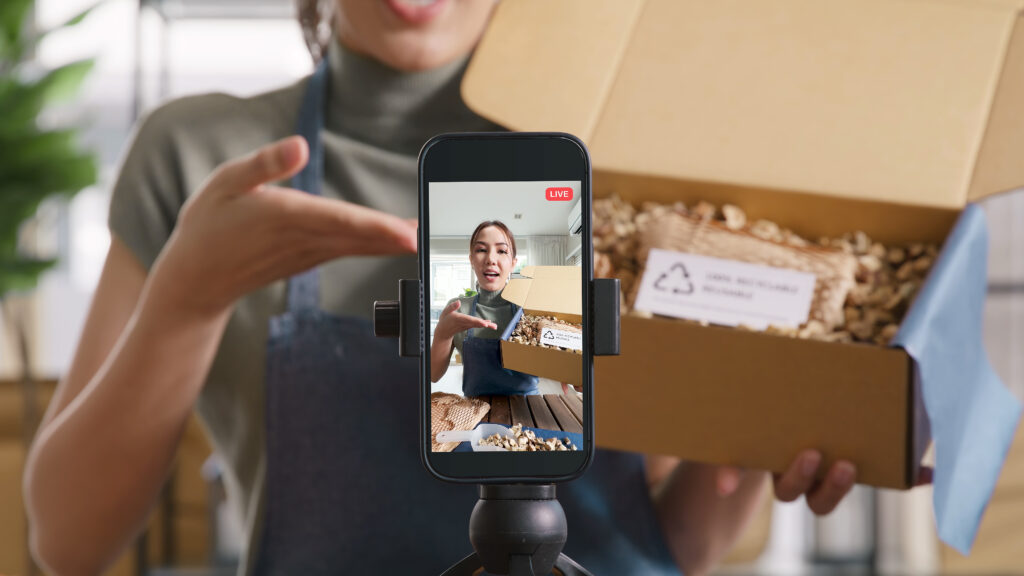
You have to unlearn. Rethink what we call “optimisation”. On TikTok, for example, there is no link. No page. Just a video. Thirty seconds, sometimes less. That is where everything has to happen. A hook. An emotion. A clear intention 💡. And then the algorithm does the rest. If it works, it spreads. If not, it dies in silence.
On Instagram, the same logic applies. Visibility is earned through engagement, not through indexing. Shares, comments, reposts. Those are the relevance signals. Not a neatly structured H1-H2-H3 hierarchy.
YouTube? It is a mix of the two. Long content, but it has to start strongly. Capture attention in the first ten seconds. And above all, create a connection. A voice. A presence. The algorithm recognises loyalty, not just keywords.
Put another way: SEO is not disappearing. It is recomposing itself. It is expanding. It is spilling over. And for anyone still working the way they did in 2018, that is a shock. But for everyone else, it is an opportunity. An enormous one.
Knowing where to put your energy
Provided you know what you are looking for. And where you want to be seen. Because not everyone needs to be on TikTok. It all depends on what you sell. To whom. And how those people discover what they want.
Some brands have understood this very well, and the best examples still often come from the USA. Chipotle, for instance. No need for an optimised blog. They string together short formats, launch challenges and hashtags. The message lands. Not through text. Through action.
Gymshark too. Raw content, filmed by users. Real bodies, workout routines you could actually copy. No polished staging. No heavy storytelling. Just the emotion of the moment.
Even banks are getting involved, and this time in Europe. N26 has grasped what is at stake with voice. They optimise for Siri, for Alexa. They answer real questions, asked out loud, in a natural way. And it works. Because it is designed for that.
What do all these companies have in common? They stopped producing content in order to rank well. They create formats that circulate. That get passed on. That take root in habits, not in keywords.
That is where the real SEO of 2025 is decided. Not in dashboards. In feeds. In voices. In the thumbs that stop on a screen.
Adapting your strategy, without falling into caricature
For those who want to take their strategy further, there are a few directions worth exploring. Not magic recipes, no. But solid leads.
- Think platform first. No longer engine. Create for TikTok, for Insta, for YouTube. With their codes. Their language.
- Work on the hook. Every piece of content, short or long, has to capture attention in three seconds. Otherwise it is lost.
- Betting on voice. Literally (voice search) and figuratively (tone, rhythm, way of speaking).
- Do not neglect the visual. The image no longer illustrates the point: it is the point. The entry point.
- And above all: give others a voice. Users, clients, ambassadors. Authenticity cannot be manufactured. It is shared.
There it is. No perfect plan. No ten-step strategy. Just a reality to look in the face. And a course to adjust, slowly but surely.
📚 Sources for this article (nothing was pulled out of a hat)
- Deloitte – Digital Media Trends 2025🔗 Link
“Gen Z continues to drive the shift to short-form, creator-driven content, where entertainment and information blur into one experience.”
- Forrester – Predictions 2025🔗 Link
“In 2025, Gen Z’s preference for community-based discovery over traditional search will force brands to rethink how they surface information.”
- NielsenIQ – Gen Z Spending Power (2025)🔗 Link
“Social discovery is now the first step in Gen Z’s purchase journey — not the search bar.”
- Think with Google: Voice Search & Mobile Stats🔗 Link
“27% of the global online population is using voice search on mobile — and Gen Z leads the trend.”
- Gartner – Search Engine Disruption (2024)🔗 Link
“By 2026, traditional search volume will drop by 25% as AI chatbots and social algorithms dominate discovery.”