It is every digital manager’s nightmare: your articles are in first position, your keywords are relevant, and yet your traffic collapses. Welcome to the era of “Zero Click”.
In 2026, Google is no longer a simple library of links. With the massive rollout of the Search Generative Experience (SGE), the search engine has become an answer engine. Why would a user click on your site if Google’s AI has already extracted, summarised and displayed your conclusion directly on the results page?
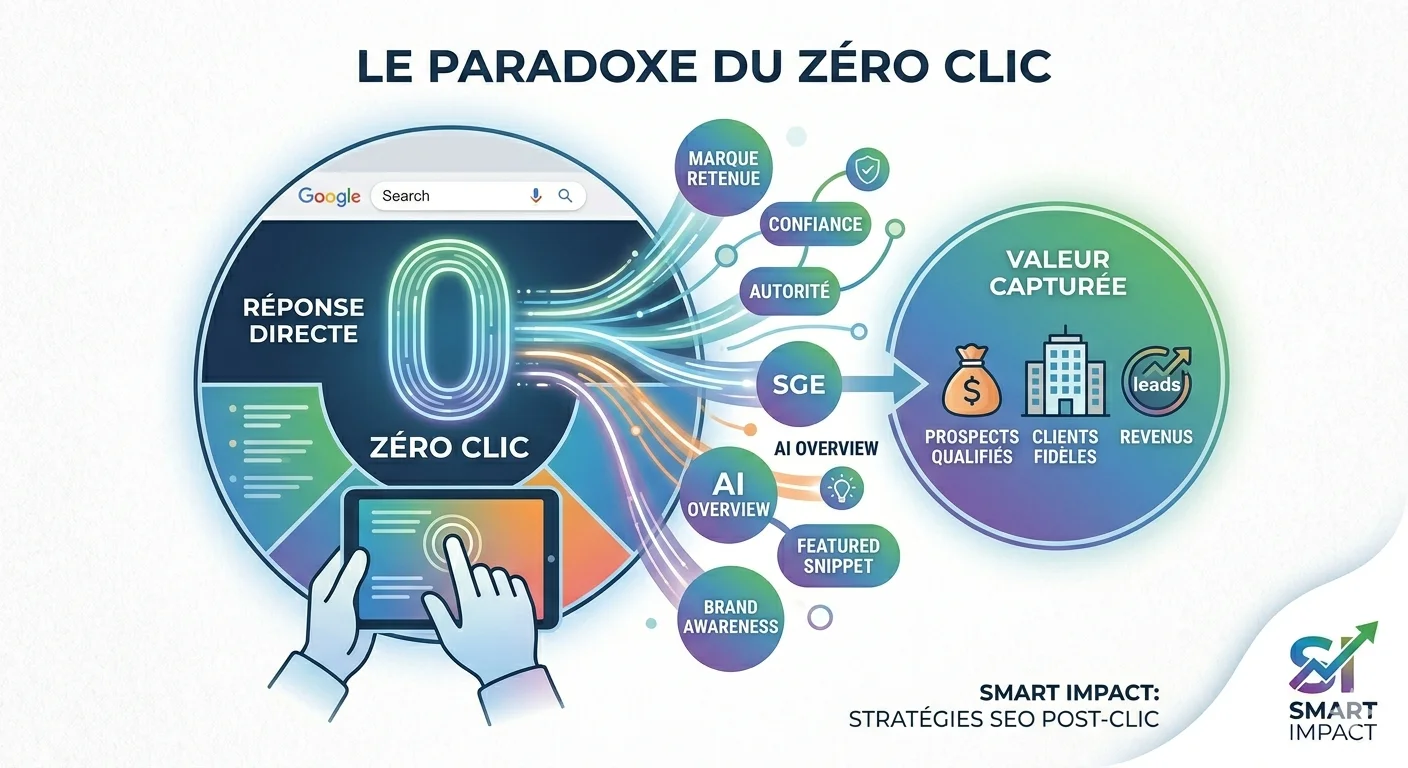
Today, more than 60% of searches end without a single click. For many, that is a dispossession, even a “theft” of intellectual property. At Smart Impact, we see it as a deep shift in digital influence marketing. The paradox is right there: you can lose visit volume while gaining authority and conversion. The challenge is no longer to force the internet user through your door, but to make sure that, when they get their answer on Google, it is your name they remember as the absolute reference.
How do you capture value when the click disappears? How do you stay indispensable in a world where AI acts as the filter? Here is our strategy for turning “Zero Click” into a powerful branding lever.
Understanding the “Zero Click” era: the new faces of SEO
Since 2024, the search landscape has mutated. Google has stopped being a simple directory and become a final destination. To capture value, you first have to understand the three formats that “steal” your clicks, but build your reputation.
1. SGE (Search Generative Experience) and AI Overviews
This is the most radical change. At the top of the page, a block generated by AI answers the user’s question directly by synthesising several sources.
- The effect: the user gets their answer (e.g. “What obligations does the Swiss data protection act place on a Geneva SME?”) without ever leaving Google.
- The opportunity: if the AI uses your content to build its answer and shows your link in its “carousel of sources”, you gain instant credibility. You are no longer a mere result, you are the evidence the AI is leaning on.
2. Featured Snippets and “Position Zero”
The traditional “box” at the top of the results has evolved. It has become richer and more interactive.
- The trap: it often answers the question so well that the click becomes unnecessary.
- The pivot: for brands, appearing here is no longer a traffic acquisition strategy but a strategy of occupying space. If your brand fills 50% of the screen before the first blue link, you dominate share of voice.
3. People Also Ask (PAA) and micro-intents
Google now breaks complex searches down into a series of secondary questions.
- The behaviour: the visitor clicks a question, reads the answer that unfolds, then clicks another. Each interaction strengthens a brand's presence in the user's mind.
- The reality: the click to the site does not happen, but the interaction with the brand's content did take place, on Google's interface.
The Smart Impact observation: in 2026, SEO is no longer measured in “sessions” but in “qualified impressions”. If Google answers in your place, make sure the answer carries your invisible signature.
FURTHER READING: AI SEO tools: why SEO specialists are genuinely changing their habits
Strategy no. 1: Becoming the source cited by AI (optimising for attribution)
In a world without clicks, visibility is your new currency. If Google uses your data to answer the searcher, you have to make sure it does not simply “plunder” you, but credits you heavily. Here is how to maximise your “citation rate” with AI.
1. Structuring data (Schema.org)
For Google’s AI (SGE) to be able to cite you, it must understand your content unambiguously. In 2026, structured data has become the native language of SEO.
- Moving to “speakable”: use the markup to identify the parts of your text that answer questions directly.
- Expert markup: use the Review, CaseStudy or Organization schemas to tie your brand name to precise expertise. The stronger the link in Google's Knowledge Graph, the more AI will favour you.
2. The “Snippet-Bait” method
AI loves formats it can digest easily. To be cited, your content must include “blocks of truth”:
- The 40-50 word rule: place a clear, concise definition immediately after an H2 or H3 heading. That is the ideal format for Google to extract it.
- Logical bullet lists: step-by-step procedures are the favourites of AI-generated answers. They increase your chances of appearing in the carousel of sources.
3. “Brand-Keyword Association”
The aim is to create an inseparable semantic link between a problem and your brand.
- The strategy: if you publish regularly on “the Swiss data protection act”, Google should end up treating the two as inseparable.
- The result: when AI generates an answer about the Swiss data protection act, it will naturally include a sentence such as “According to the experts at Smart Impact, the crucial step is…”. Even without a click, your authority is anchored.
4. Optimising original images and graphics
“Zero-Click” also applies to images. Users consume a huge amount of information through Google Images or the thumbnails built into AI answers.
- Visual branding: in 2026, every chart and every infographic has to carry your logo and your URL, elegantly but legibly.
- The effect: if the user gets their answer through your chart in the SGE, they have seen your logo. The awareness objective is met.
TO READ: Marketing data & emotion: the secret behind the ROI of Swiss companies
Strategy no. 2: Creating content that is “unclickable” by AI
If Google can summarise your article in three bullet points, your content did not add enough value. To earn the click in 2026, you have to offer what language models (LLMs) cannot produce: human experience, nuance and interactivity.
1. Injecting subjectivity and a clear-cut opinion
Google’s AI is programmed to be neutral, consensual and cautious. It is excellent at the “What”, but poor at the “So what?”.
- The lever: do not settle for stating facts. Take a position. Use headings such as “Why strategy X is a fatal mistake for Swiss SMEs in 2026”.
- The effect on clicks: AI will summarise the facts, but the reader will click to understand your unique reasoning and your expert view.
2. The “gatekeeping” of raw data
AI can summarise an analysis, but it cannot recreate an interactive database or a complex tool.
- Calculators and simulators: someone trying to work out their tax savings or their advertising ROI will not be satisfied by a text. They want a tool.
- Proprietary data: if your article mentions “our internal study of 500 companies in French-speaking Switzerland”, AI will cite the key figure, but the serious reader will click to see the methodology and the detailed charts.
3. Storytelling and lived experience (E-E-A-T)
AI has no body, no emotions and no past. It cannot tell the story of “how we saved this client from bankruptcy in 48 hours”.
- The “immersive case study” format: turn your articles into logistical or human narratives. The reader is no longer looking only for information, they are looking for lived experience.
- The effect on clicks: human curiosity about real stories is a driver of clicks that AI will never entirely extinguish.
4. The principle of informational “teasing”
Structure your articles to give the answer immediately (to please Google), but promise a practical solution further down.
- Example: “Google's AI answers the technical question. Our article gives you the ready-made Excel template to apply it.”
- The Smart Impact tip: give the “what” to AI for visibility, but keep the “how to do it” for the website.
 Photo by Carl Heyerdahl on Unsplash
Measuring success beyond the click: the new KPIs
If you keep judging the health of your SEO solely on incoming traffic volume, you will wrongly conclude that your strategy is failing. In 2026, performance is measured by the share of mind you occupy, and no longer only by Google Analytics sessions.
1. “Share of Model” (share of voice in AI)
This is the king of KPIs in the post-click era. It is about measuring how often your brand is cited by SGE or ChatGPT when a question related to your sector is asked.
- The indicator: what percentage of the answers generated on your strategic keywords include a link to your site or a mention of your brand?
- The stake: a high “share of model” makes sure you stay in the buyer's consideration set, even if they do not visit your site straight away.
2. “Brand Lift” through direct searches
Zero-click is not a dead end, it is often a detour. Someone sees your answer on Google, registers your expertise, and comes back later by typing your name directly.
- The measure: watch the increase in the volume of searches for your brand (branded search) in Search Console.
- The diagnosis: if your SEO traffic falls but your direct searches rise, that is a sign your “position zero” visibility is turning Google into a highly effective branding channel.
3. Assisted CTR and the multi-touch journey
A user can see three of your answers in “People Also Ask” without clicking, then finally convert through a LinkedIn ad or a newsletter because they have “already seen your name somewhere”.
- The tool: use marketing attribution models that value SEO impressions (even without a click) as touchpoints in the conversion funnel.
4. Conversion Rate per Visit (quality vs quantity)
The Zero-Click paradox has a positive side effect: it filters out the tourists.
- The phenomenon: the people still clicking through to your site are the ones who did not find a sufficient answer in Google's summary. They are far warmer, better qualified leads.
- The KPI: if your traffic falls by 30% but your number of leads stays stable, your conversion rate has soared. Your SEO has become more efficient.
Turning Google into a branding channel
SEO is no longer about “chasing the click”, but about owning the answer. By accepting to give value away for free directly on the results page, you buy the most expensive thing on the Internet: trust.
The companies that do well in 2026 will be those that stop fighting the algorithms and start working with them. Give Google what it wants (clear answers), and you build the conditions for what you actually need: a brand authority no one can take away from you.
Is your SEO strategy still stuck in 2024?
Do not let SGE drain your sales funnel. At Smart Impact, we help French-speaking Swiss brands pivot towards a strategy built around AI answers. Contact us for an audit of your post-click visibility.