
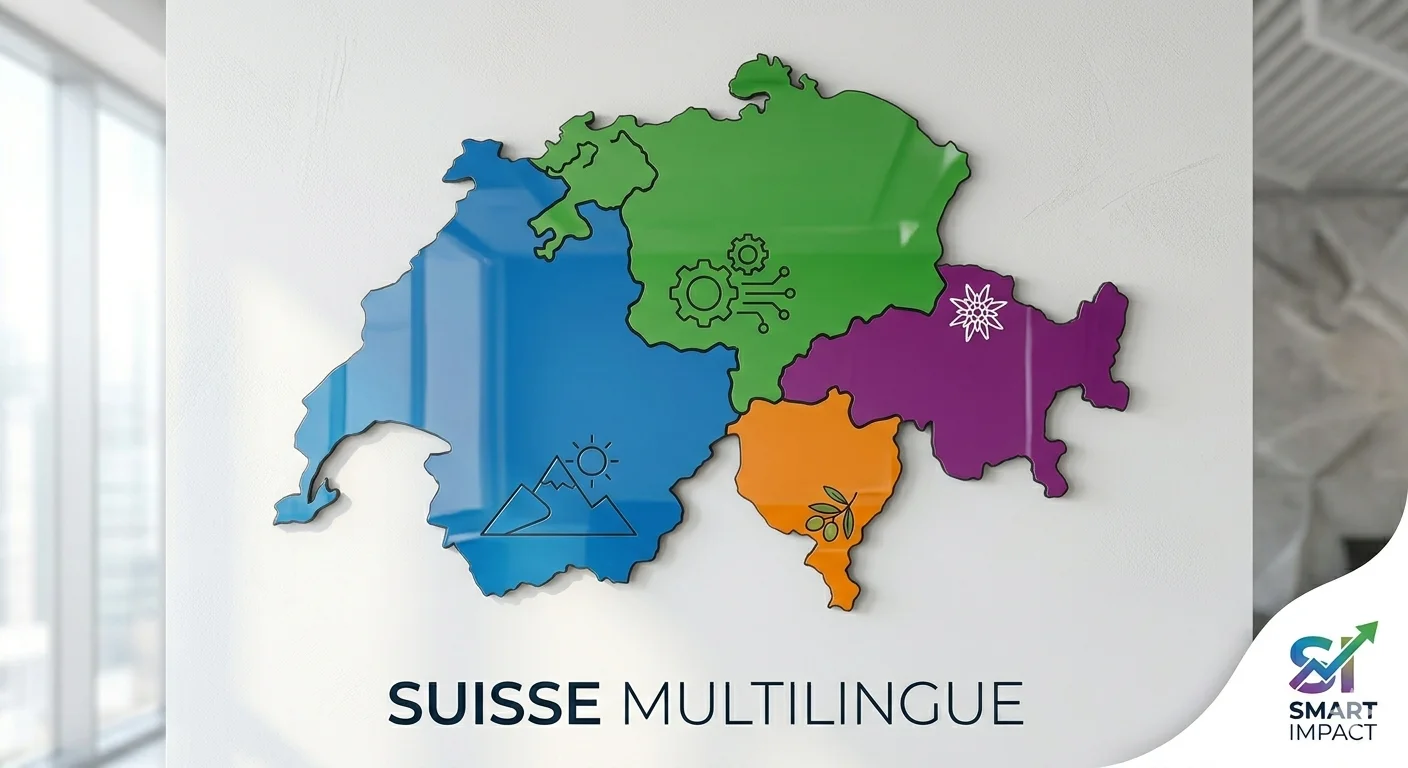
When it comes to digital, Switzerland is not a market, it is a laboratory of complexity. With four national languages and search behaviours that differ radically from one canton to the next, Swiss SEO leaves no room for approximation.
Yet many companies still make the mistake of treating Switzerland as a simple extension of France or Germany. In 2026, if you settle for a literal translation, you are not optimising: you are disappearing.
The translation illusion: why is translating not the same as optimising?
The first trap of multilingual SEO is believing that a good translator (or a capable AI) is enough to rank you on Google.ch.
The war of synonyms and Helvetisms
A user in Geneva does not search the way a user in Paris does.
- In France, people look for a “téléphone portable”. In French-speaking Switzerland, they look for a “mobile” or a “natel”.
- If you optimise only for the standard French term, you miss out on 30 to 40% of local search volume.
Search intent varies by culture
The German-speaking market (Deutschschweiz) is often more oriented towards technical precision and price comparison, while the French-speaking market can be more sensitive to brand image and storytelling. Your keywords have to reflect these psychological nuances.
FURTHER READING: AI SEO tools: why SEO specialists are genuinely changing their habits
Technical infrastructure: the foundation of your visibility
For Google to understand that your site addresses three distinct audiences, you need to send it the right technical signals.
1. The Hreflang tag: your language switch
This is the crux of the matter. hreflang tags tell Google which version of the page to display depending on the user’s location and language. One misconfiguration and it is the German version that appears in Lugano, ruining your conversion rate.
2. URL structure: subdirectories or subdomains?
- mysite.ch/fr/: the recommended solution for most Swiss SMEs. It concentrates the authority of the main domain across every language.
- fr.mysite.ch: useful only for very large structures with entirely separate stock or service management by region.
3. Local hosting
For effective Swiss SEO, server proximity matters. Hosting your data in Switzerland is not only a sign of trustworthiness for the LPD (Swiss Data Protection Act), it is also a signal of local relevance for the algorithm.
The German-speaking Switzerland challenge: “Hochdeutsch” vs reality
The German-speaking market accounts for around 70% of Switzerland’s economic potential. It is the most lucrative, but also the most complex.
- The language paradox: people write in standard German (Hochdeutsch) but think (and sometimes search) in dialect (* Schwiizertüütsch*).
- The Smart Impact tip: build typically Swiss German expressions into your meta tags and your FAQ to create immediate closeness. A client in Zurich has to feel that you are not a Berlin company trying to sell them a service.
Ticino: the (unfairly) neglected corner of Swiss SEO
Too often, the Italian-speaking market is neglected or handled with mediocre machine translation.
- The opportunity: SEO competition in Ticino is often far less fierce than in Zurich or Geneva.
- The ROI: a site perfectly optimised in Italian for the Ticino market can capture market share quickly on a contained investment. It is often the “quick win” of a national strategy.
TO READ: The ROI of Generative AI: how do you measure your marketing team’s productivity gains?

Checklist: is your Swiss SEO ready?
To compete for the SERPs from Geneva to Lugano via Zurich, your set-up must be surgical. Use this list to audit your national presence.
1. Technical setup: Hreflang tagging
Hreflang is your site’s passport. Without it, Google may penalise your content for “duplicate content” or fail to show the right language to the right user.
- Geographic targeting: are you using the country code -CH properly? (For example: fr-CH, de-CH, it-CH.) That tells Google your content is designed specifically for Swiss residents and not for French or German ones.
- Self-reference: does every page carry a tag pointing to itself as well as to its alternative versions?
- Fallback page (x-default): have you set up a default page for users whose language matches none of your versions (for example an English-speaking expatriate in Basel)?
2. Semantics: the “Swiss-specific” lexicon
Google’s AI understands local context. If you speak “French from France” on a .ch domain, you lose relevance.
- Built-in Helvetisms: have you replaced “soixante-dix” with “septante” and “déjeuner” with “dîner” (depending on the context)?
- Search keywords: has your keyword audit been redone for each language? (A reminder: in German-speaking Switzerland people do not search for “tapis de sol”, but usually for “Fussmatten”, a term that differs from standard German.)
- The “Natel” test: for technology or everyday consumer products, do you use the brand terms that have become generic nouns in Switzerland?
3. Local trust signals
Swiss internet users are demanding about origin and reliability. Google uses these signals to validate your authority.
- Physical contact details: are your Swiss address and telephone number (+41) clearly visible in the footer and on your contact page?
- Google Business Profile: have you created and optimised a profile for each physical branch? (A profile in Geneva and one in Zurich help strengthen your local SEO in each region considerably).
- Legal notice (Impressum): is your Impressum page compliant with Swiss law and translated into the target languages?
4. User experience (UX) and conversion
A well-ranked site that does not convert is a wasted investment.
- Single currency: the symbol CHF is it used everywhere? Displaying prices in Euros is the fastest way to drive a Swiss visitor away.
- Local payment methods: do you mention Twint in your payment structured data or on your conversion pages? That is a strong signal of cultural relevance.
- Local loading speed: is your server located in Switzerland, or do you use a CDN with nodes in Zurich or Geneva to minimise latency?
5. Links and authority (netlinking)
Multilingual SEO does not stop at your site. It also concerns your digital neighbourhood.
- Regional backlinks: do you have links from influential .ch domains in each region? A link from a French-speaking Swiss newspaper will not have the same impact on your German version as a link from a Zurich portal.
- Swiss directories: are you listed in the leading directories (Local.ch, Search.ch) with consistent information (NAP: Name, Address, Phone)?
The Smart Impact expert view: if you tick fewer than 4 boxes on this list, your site is probably working against your commercial interests. SEO in Switzerland is not a cost, it is a strategic asset that needs high-precision maintenance.
Switzerland does not divide, it multiplies
Multilingual SEO in Switzerland is a surgical discipline. By respecting the linguistic and cultural specifics of each canton, you do not only please Google: you build a relationship of trust with your audience.
In a country where closeness is a refuge value, showing that you speak the same language as your client (literally and figuratively) is your best competitive advantage.
Need to reach the other language regions?
From Geneva to Lugano, by way of Zurich, Smart Impact supports your national expansion. Our experts know the subtleties of the Swiss market and can carry your visibility beyond the Röstigraben.