

Acquiring a new technology (software, AI, collaboration tool) is a crucial strategic decision. Yet a brilliant technology that is poorly received by teams quickly turns into wasted investment. The leader’s role does not stop at signing the cheque; it starts the moment the announcement is made.
The successful rollout of a new system is not technical, it is above all human. It depends on the leader’s ability to defuse fear, create enthusiasm and show the individual benefit of the tool. That is the essence of *change management *: turning anxiety into a driving force.
Discover our guide in three strategic phases for introducing a new technology calmly and effectively, supporting durable adoption and a fast return on investment.
Phase 1: securing trust before the announcement
Before even presenting the tool, the leader must prepare the ground by tackling the fear of the unknown, which is the first obstacle to adoption. Communication must be proactive and empathetic.
Addressing the fear of obsolescence (AI anxiety)
The first question anyone asks when facing a new machine is: “Am I going to be replaced?” or “Is my know-how going to become useless?” If that fear is not addressed, employee resistance will be immediate.
- Action: the leader has to communicate clearly about the future role of people.
| The employee's fear | The leader's message (empathy) |
|---|---|
| Fear of being replaced | “The tool is there to make you more capable, not to replace you. Your role becomes more strategic.” |
| Fear of the unknown | “We are all going to learn together. Your business expertise is more valuable than ever in guiding this tool.” |
| Fear of surveillance | “Technology supports performance, it is not a tool for intrusive surveillance.” |
Identify and engage the “champions”
Every organisation has naturally curious or influential people. Getting them on board early is key to spreading a positive message.
- Action: set up a co-creation committee before the rollout.
- Role of the Co-Creation Committee:
Test the tool in beta.
- Provide feedback on usability.
- Becoming the ambassadors of the transition, reassuring their peers on the ground.
FURTHER READING: the psychological biases in the adoption of AI technologies.

Phase 2: communicating the vision (the strategic announcement)
The announcement should not be a presentation of features, but an explanation of the strategic vision (the Big Why) and of the individual benefit (What’s In It For Me, or WIIFM).
The leader has to sell the “why”
Employees need to understand why this change is vital for the company and for its customers.
- Action: always connect the new technology to a concrete improvement in the customer experience or in competitiveness.
| Poor communication (technical focus) | Good communication (strategic focus) |
|---|---|
| “We are installing a new CRM for data centralisation and reporting.” | “We are installing a new CRM so a client never has to repeat their history again, and to improve client loyalty.” |
| “We are bringing in AI for algorithmic optimisation.” | “We are bringing in AI to free up 2 hours of your day from administrative tasks.” |
Making sure the “WIIFM” is clear
The leader has to make sure that every user immediately sees how the tool makes their life simpler or lets them work better.
- Action: provide immediate use scenarios by role.
- Examples of individual benefits:
- Saving time: automating the reports.
- Perform better: access to more complete client data.
- Less frustration: a tool that can finally integrate with the others (avoiding the Cognifatigue that comes from juggling multiple systems).
Phase 3: ensuring adoption (after the rollout)
Lasting adoption requires turning theoretical training into a practical discipline of use, steered by frontline management.
Leading by example
The leader has to be the first visible user of the tool. If line management works around the technology (e.g. asking for information by email instead of checking the new CRM), adoption is doomed to fail.
- Action: make using the new technology a non-negotiable step in management rituals.
| The leader's steering method | Expected outcome |
|---|---|
| Use in management meetings | Show that the tool is the single source of truth. |
| The end of the “double click” | Ban requests for data that is already in the tool (management must access it themselves). |
| Recognition | Publicly recognising the teams and employees who use the new tool to its full potential. |
Replacing training with coaching
Theoretical learning is rarely enough. The leader must encourage continuous, practical support.
- Action: move from one-off “mass training” to coaching on the ground built into daily work.
- The role of the line manager:
- Identify individual friction points (bugs or personal resistance).
- Provide continuous feedback to the IT team to improve the tool (Brain-Compatible Adoption).
- Making sure the tool is used correctly for the most critical tasks.
The ADKAR method in brief
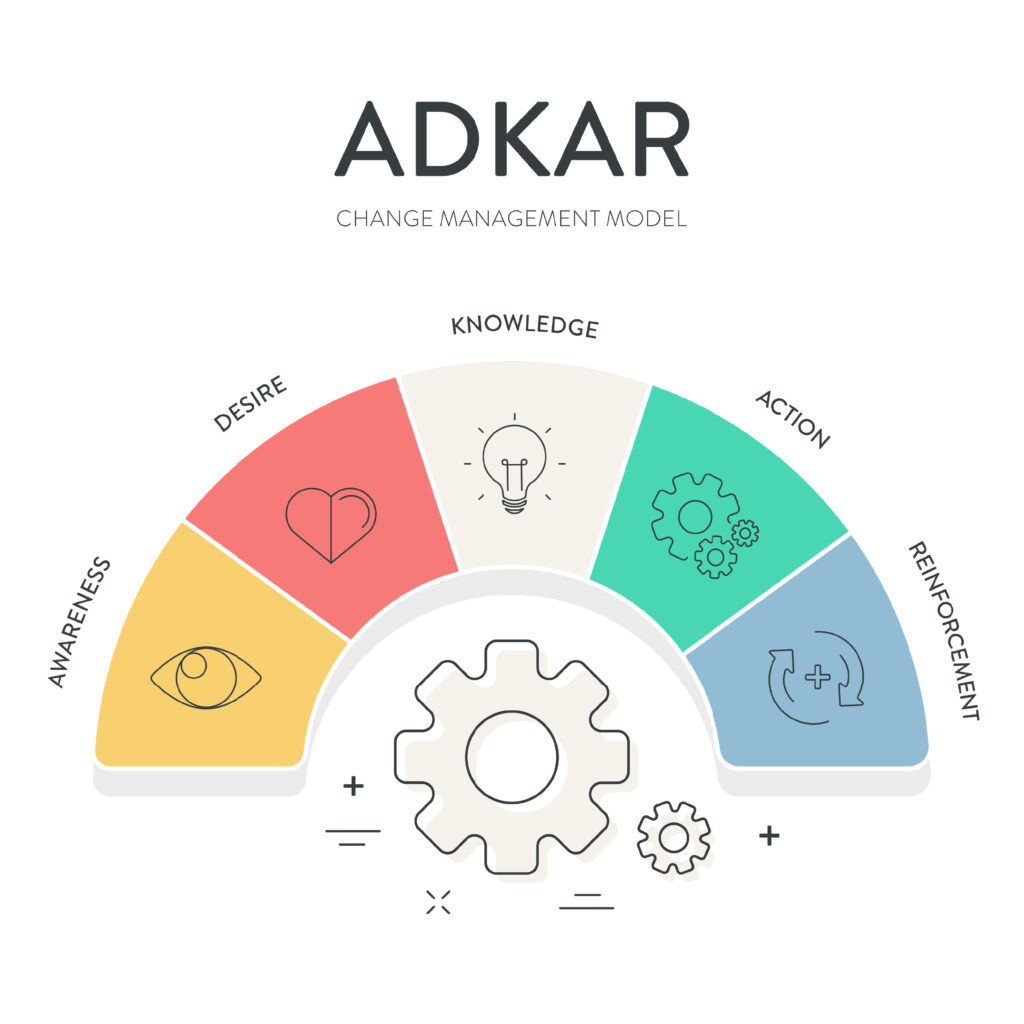
The ADKAR method is a structured change management model centred on the individual, essential to the success of any digital project.
Developed by the research and consulting firm Prosci, it sets out the five stages a person has to go through to adopt a change durably:
- A wareness (awareness of the need for change),
- D esire (the desire to take part and to support),
- K nowledge (knowing how to change),
- A bility (the capacity to put the new skills into practice),
- R einforcement (reinforcement to sustain the change).
According to Tim Creasey, Chief Innovation Officer at Prosci, successful change lies not in managing tasks but in managing these five individual outcomes: “You cannot manage organisational change without managing individual change first.” It is an essential tool for Human Resources to diagnose and defuse resistance at the individual level.
FURTHER READING: Change management: the 3 essential steps according to Kurt Lewin.
Case study: adopting the AI Assistant in a Swiss SME
Here is a concrete case study of integrating an artificial intelligence (AI) tool within a 20-person Swiss SME in B2B consulting, using the adoption principles we have explored.
1. Context: administrative overload
- ⚠️Problem: the 12 consultants and project managers spend on average 30% of their time on administrative and documentation tasks:
Writing meeting minutes (long-form summarisation).
-
Creating the initial content plans (brainstorming and first draft).
-
Competitive intelligence research (summarising articles and public reports).
-
↔️Consequence: mental fatigue, projects executed more slowly and frustration (time lost on tasks that add nothing).
-
❇️The executive’s objective: free up 20% of consultants’ time so they can focus on the client and on creative strategy.
2. The integrated AI tool: the summary and content assistant
🤖Solution chosen: a generative enterprise AI assistant (similar to ChatGPT or Copilot in a secured version) configured to access internal documents (client database, report templates) and to carry out external monitoring.
- The Role of AI:
✔️Summarising: creating immediate, actionable summaries of meetings (audio or text).
- ✔️Drafting: generating a first outline of a content plan or report structure.
- ✔️Monitoring: condensing competitive intelligence articles into key points.
3. The leader’s adoption strategy (applying the phases)
The director, Mr Laurent, adopted an introduction strategy built on trust (phase 1) and user benefit (phase 2), rather than on hierarchical authority.
A. Securing trust (before the announcement)
| Leader's action | Strategic aim (managing fear) |
|---|---|
| Announcing the vision (3 weeks before) | Mr Laurent announces that AI is the only way to absorb the current workload without hiring. The message: “AI is here to lighten our load, not to replace us.” |
| Setting up the Ambassadors Committee | A group of 4 consultants at different levels is chosen to test the tool. Their role is to identify usability bugs and to confirm the time savings for their peers. |
| Confidentiality protocol | The leader guarantees that customer data is not used to train the AI, thereby lifting the fear of information leaks. |
B. Communicating the vision (the “WIIFM” focused announcement)
At launch, the focus is not on the technology, but on the time saved by each individual.
📣The consultant’s WIIFM: “you will gain an hour a day to focus on strategy and client relationships.”
🔹Key demonstration: instead of showing the interface, Mr Laurent asks the AI to summarise the minutes of the meeting that has just ended, in front of the whole team. The impact is immediate and concrete.
C. Ensuring lasting adoption (ongoing coaching)
The key is making sure the tool is used properly once the initial euphoria has passed.
↪️A shift to coaching: training is replaced by weekly “AI hours”, where the Ambassadors help their colleagues refine their prompts for concrete tasks (* e.g. how to ask for a summary in 3 precise points for an impatient client*).
↪️The leader sets the example: Mr Laurent requires that all weekly content plans be started by AI and that project summaries be pulled from the tool. Information is no longer requested by email, it is looked up directly.
4. The results (secured ROI)
✅Adoption: the usage rate reaches 90% after 2 months for summarising tasks.
✅Time saved: consultants confirm an average saving of 45 minutes to 1 hour per day on documentation tasks.
✅Effect on the company: the team was able to take on two new small clients, because production capacity grew without adding to the administrative load. The ROI on the AI licence was paid back in 4 months through the increase in production capacity and the reduction in fatigue alone.
AI is a trust project
Introducing a new technology is a test of leadership. Success depends less on the tool than on the trust you inspire. By proactively managing the fear of replacement, by clearly communicating the WIIFM and by setting a flawless example, you turn an IT investment cost into a strategic asset for growth.
That is how you move from announcing a new technology to creating a new working culture.
💡Discover Smart Impact’s services for SMEs.
SOURCES:
- John Kotter (expert in change management): the book Leading Change.
- Prosci / Tim Creasey (adoption methodology): the ADKAR model and the case studies from Prosci.
- Simon Sinek (leadership and vision): the book Start With Why.
- Gartner (technology and HR research): reports and analysis on technology adoption.
- Amy Edmondson (psychological safety): the book The Fearless Organization.