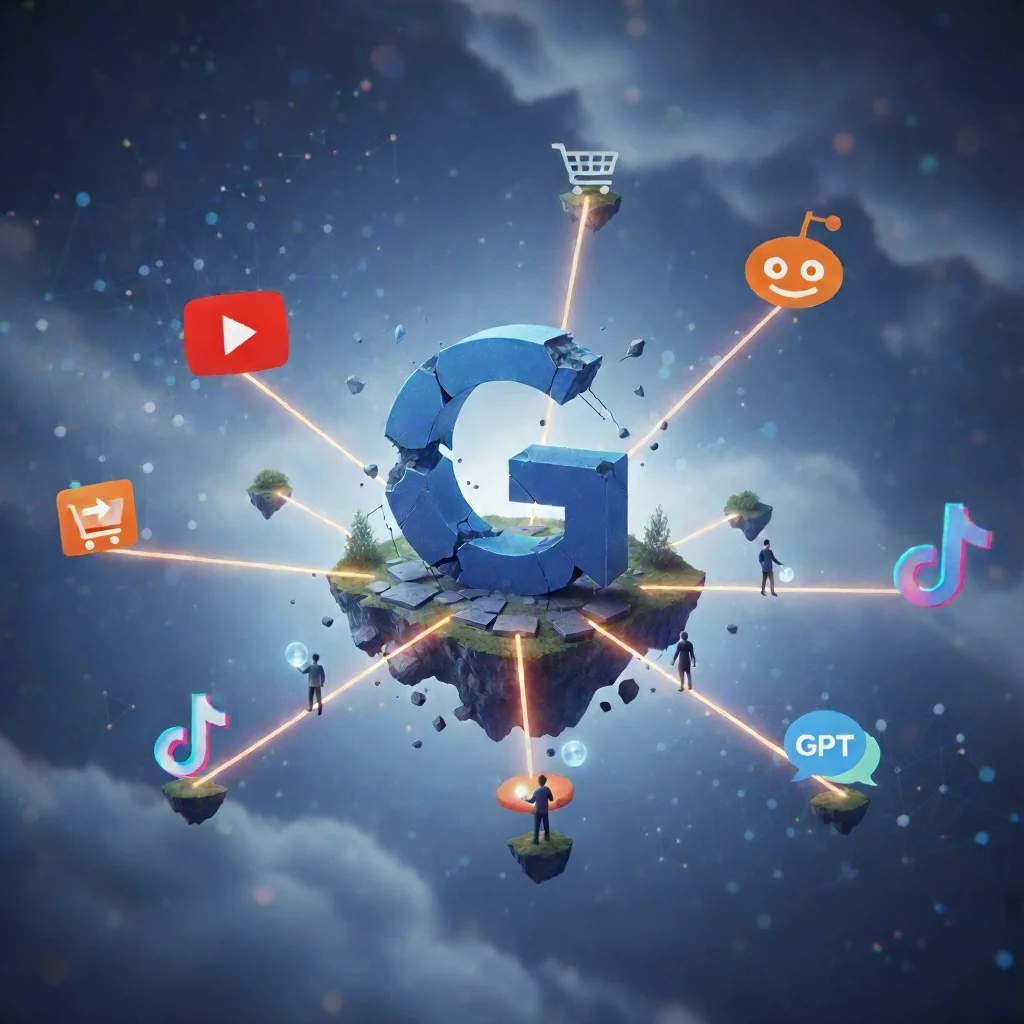
For years, Google was the doorway to the web. Ranking well meant being visible. Being visible meant existing. But that model is crumbling. People no longer “search”, they validate. They cross-check reviews, watch videos, consult ChatGPT, read Reddit, then confirm their impression on Amazon or TikTok. The search engine is no longer the centre of the world, but one node among others in an ecosystem of distributed decisions.
Classic SEO, based on keywords and position in the SERPs, is no longer enough to generate trust. What counts now is not appearing, but being credible at the moment the decision is taking shape. In this era where AIs and communities have more influence than engines, search becomes a social, emotional and algorithmic process all at once.
This change does not mark the end of search optimisation, but its widening. So we explore that transition, drawing on recent data and concrete examples, to understand how SEO is evolving towards a fuller model: Search Everywhere.
The decline of Google’s monopoly
Google remains massive. According to Similarweb, the engine still handles around 13.7 billion searches a day, but that now represents only 27% of all online search activity. The rest is scattered elsewhere: TikTok, Reddit, YouTube, Amazon, ChatGPT. The web has become an archipelago of decisions.
Behaviour confirms this shift. According to a GWI 2025 study, 32% of under-30s turn first to a generative AI to research a product before checking Google. TikTok has become a visual search engine, and Reddit a community validation engine. In practice, classic SEO captures only a fraction of what is really happening.
What this means: brands can no longer rely on a single lever. Ranking well on Google is no longer a guarantee of being chosen. Visibility without credibility is an illusion of presence.
“SEO is no longer a battle for first place, it is a strategy for the first impression.”
The new decision journey: from search to validation
Once linear, the buying journey has fragmented. The “I search, I compare, I buy” pattern has blown apart. Today, an internet user discovers a brand on TikTok, checks it on Reddit, reads the Amazon reviews, then asks ChatGPT whether it is reliable. All of that, often, without ever visiting the official site.
Case studies confirm it. Glossier, a cosmetics brand born on Instagram, saw its organic traffic drop by 18% in 2024. Yet its sales grew thanks to TikTok virality and Reddit discussions mentioning its products. Dyson, for its part, paired its YouTube tutorials with Reddit threads to validate its technology with technical communities: the result: +28% “comparison” queries on Amazon in three months.
These examples illustrate a new truth: a decision is built through an accumulation of micro-proofs. It is not linear, but a mosaic. Every mention, every review, every recommendation becomes a small trust signal within a wider cognitive network.
This is where the notion of multi-touch attribution comes in. No touchpoint acts alone. A video sparks desire, a review confirms it, an AI query validates it. Performance is no longer measured by a click, but by a sequence of emotions and validations.
Search Everywhere: a model for the decision-making web
The Search Everywhere concept is not about abandoning Google, but about understanding that every platform is a decision engine with its own logic. SEO, in that context, becomes ecosystem work.
TikTok sparks desire: decisions there are impulsive, driven by novelty and emotion. YouTube reassures: long videos embody expertise and demonstration. Amazon settles it: reviews are the ultimate social proof. Reddit validates: authenticity beats marketing. ChatGPT and AI tools synthesise: they cite the sources they judge reliable and consistent.
Each channel reaches a distinct mental moment for the consumer: curiosity, reflection, comparison, confirmation. The question is no longer “where to publish”, but “when to be present”.
This polycentric view of search optimisation calls for a deep redefinition of content: produce less, but better. Create to be cited, shared and integrated, not merely indexed.
From visibility to validation: a relationship, not an opposition
Setting visibility against validation would be a mistake. The two feed each other. Visibility opens the door, but validation gets you in. Effectiveness lies in the balance between discovery and trust.
Three complementary levels can be distinguished:
- Discovery: Google, TikTok, AI, the initial spark.
- Credibility: Reddit, YouTube, reviews, the proof as it is perceived.
- Reinforcement: citations, comparisons, cross-mentions, the consolidation stage.
A concrete example: a startup mentioned in several Reddit discussions, picked up in a Medium article, then cited by ChatGPT in response to a query. Within a few weeks, it builds a network of validation that influences both humans and algorithms. AI systems read these signals as authority indicators.
The key is to think in terms of a trust network. Every positive interaction feeds the other platforms. SEO is no longer a strategy of exposure, but an engineering of credibility.

Building a strategic presence: from RICE to RACE
The Search Everywhere concept only makes sense if it comes with a clear method. Two frameworks can complement each other: RICE to prioritise, and RACE to execute.
RICE helps decide where to invest your energy:
- Reach: how far does it carry? (TikTok: massive, LinkedIn: targeted)
- Impact: what effect does it have on your objectives?
- Confidence: do you have the skills to succeed at it?
- Ease: how easy is it to carry out?
Once the channels are selected, RACE structures the rollout:
| Step | Objective | A concrete example |
|---|---|---|
| Reach | Choosing the right channels | YouTube + Reddit for a B2B brand |
| Act | Creating decision-stage content | Testimonials, case studies, demonstrations |
| Convert | Strengthen social proof | Customer reviews, AI citations, comparison articles |
| Engage | Maintaining trust | Newsletter, FAQ, community contributions |
This dual approach avoids spreading yourself thin. An SME can concentrate 80% of its effort on two key platforms and generate more conversions than by trying to be everywhere at once. Consistency beats omnipresence.
AI, trust and the future of SEO
The search engine is no longer an interface, it is a network of conversational AIs. ChatGPT, Perplexity, Gemini or Copilot already shape the answers visible to millions of users. And these AIs do not display pages: they select brands.
Their logic rests on consistency and citation. A brand that is often mentioned, semantically consistent and well connected to other reliable sources will have a better chance of appearing in generative answers. That is what some already call “GEO” (Generative Engine Optimization).
Optimising for AI means:
- Producing clear, structured content with no semantic ambiguity.
- Being cited on recognised platforms (media, forums, studies).
- Strengthen cross-cutting trust signals (reviews, backlinks, social mentions).
Authority signals are not disappearing, they are changing shape. AI does not look for backlinks, but for evidence of consensus. A brand that is often mentioned, semantically consistent and well connected to other reliable sources will naturally be favoured by language models.
The next indicators to watch:
- Citation frequency in generative AI systems.
- Presence in Reddit discussions and authentic reviews.
- Pick-up rate by specialist media and expert sources.
In time, the strongest brands will be those that have managed to become interconnected trusted references, visible in searches, but above all chosen in conversations.
Being chosen rather than being seen
SEO is not dying, it is broadening. Google is no longer the sole judge, but one player among others in a market for trust. Performance is no longer measured in traffic, but in cumulative credibility.
The future of SEO rests on three pillars:
- Consistency: one unified message across the platforms.
- Targeted presence: being where the decision is made, not everywhere.
- Distributed validation: multiplying the independent points of proof.
The change is already under way. Brands that adapt to it early give themselves a better chance of organic visibility in AI engines, of being mentioned in conversations and of being cited spontaneously in generated content. Those that stay fixed on Google may see their traffic stagnate, even with good rankings.
In 2026, the real question is no longer “how to be found”, but “how to be chosen”. And the answer lies less in the algorithms than in the trust you inspire.
SEO is no longer an art of position. It is an art of conviction.