For many company directors in French-speaking Switzerland, Artificial Intelligence (AI) is still seen as a complex file on the IT manager’s desk. It gets talked about as “software”, as a “tool” or, in moments of doubt, as a threat to team cohesion. Yet this purely technical view is precisely what is holding your growth back.
What if we changed perspective?
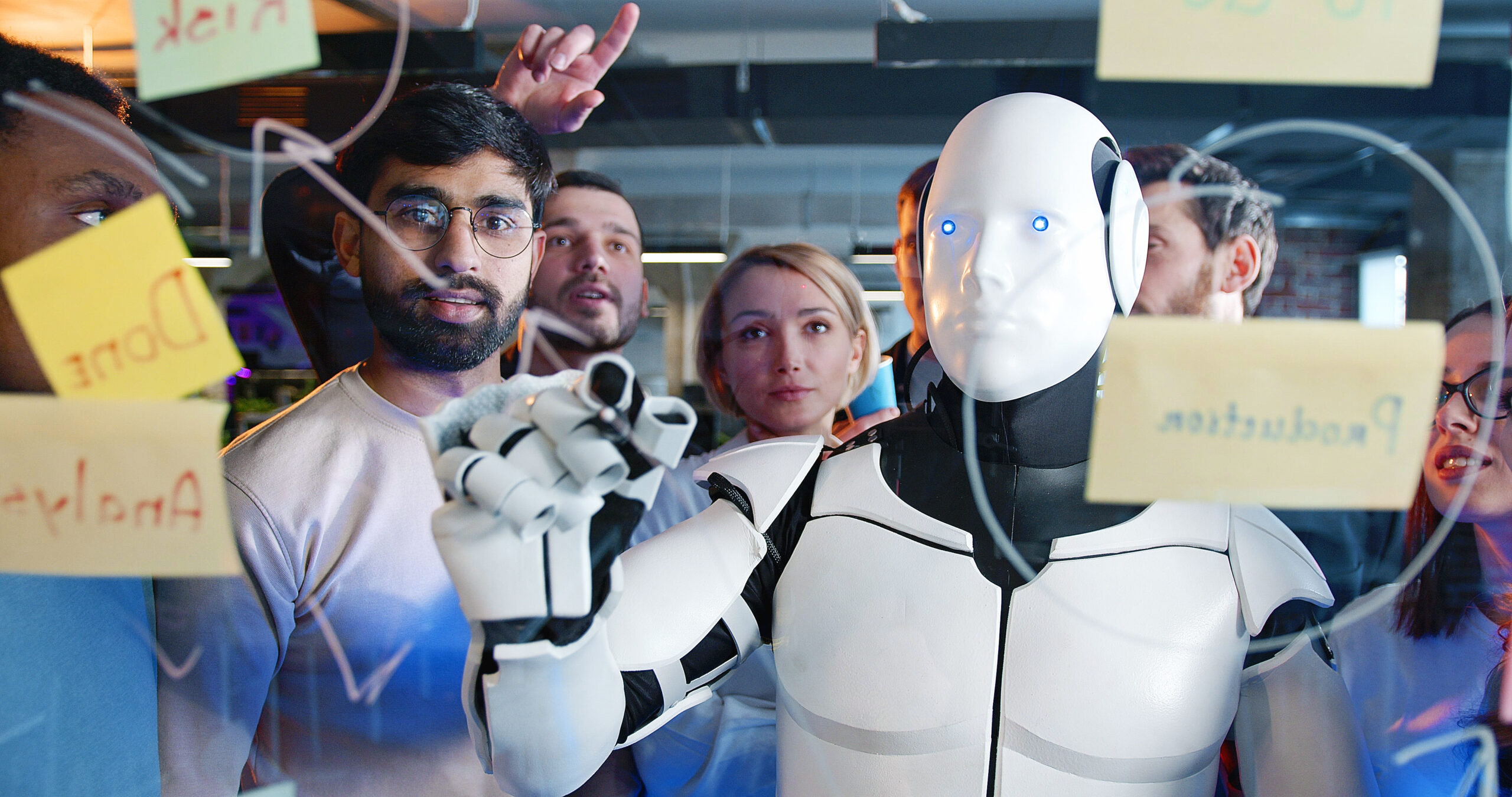
Imagine that AI is not just another piece of software, but your next hire. A “brilliant junior” colleague, able to read 5,000 pages in seconds, summarise complex reports and stay even-tempered around the clock.
Hesitation about integrating AI does not come from a lack of budget, but from a management challenge. You do not deploy an AI, you onboard it. You do not install it, you entrust it with a mission.
Discover how to turn this technological “foreign body” into a valuable colleague which, far from replacing your teams, will finally let them express their full human potential.
Your AI colleague’s job profile: a “brilliant junior”
To integrate AI properly, you first need to define its responsibilities. As with any new colleague, if its remit is vague, it will be ineffective.
In tomorrow’s org chart, AI holds a hybrid position: that of the supercharged assistant.
1. Its “hard skills”: power and speed
AI becomes the ideal colleague for all the tasks that exhaust the human brain through their repetitiveness:
- Instant summarising: it can summarise the key points of ten Zoom meetings or annual reports in a few seconds.
- Data analysis (with no fatigue bias): it spots trends in your Excel files that the human eye would only see after days of analysis.
- Help with creating: it beats the blank page by suggesting presentation structures or email drafts.
2. What it cannot do (the human stronghold)
This is where the business owner should be reassured: AI is not a leader.
- It has no intuition: it predicts the next word, it does not predict the market with political finesse.
- It has no empathy: it can write an apology, but it will not sense a client's irritation over a business lunch.
- It lacks critical judgement: without human supervision, it can state falsehoods with complete assurance.
3. The “Centaur vs Cyborg” concept
In the research world (notably the work of Ethan Mollick at Wharton), two types of collaboration with this new colleague are distinguished:
- The centaur: human and AI work separately on different tasks. The human delegates the “calculation” part and keeps the “strategy” part.
- The cyborg: human and AI are completely interwoven. The human writes a sentence, the AI finishes it, the human corrects it.
➡️ The challenge for you as a business leader: determining which form of collaboration will best serve your business objectives.
Why your employees need it (even if they are afraid)
One of the biggest leadership mistakes is thinking that if you do not give your teams AI, they will not use it. In reality, the need for productivity is such that your employees are probably already using it, but in the shadows.
1. The danger of “Shadow AI”
This is technological “ghosting”. Since the company offers no official framework, employees use free versions of consumer tools on their personal accounts.
⚠️ The risk for your company: your confidential data (accounts, client files, trade secrets) is sent to external servers to train public models, with no legal protection whatsoever.
By providing an official, secure “AI colleague”, you are not just modernising: you take back control of your information assets.
2. Freeing people from “robotic” tasks
We often ask brilliant human beings to behave like robots: sorting rows, copying and pasting data, reformatting reports. That is where disengagement is born.
- AI takes the donkey work: it handles the structure and the sorting.
- The human keeps the “added value”: they handle interpretation, nuance and the decision.
In 2026, talented people will not stay in a company that forces them to work “the old way”. AI is no longer a luxury, it is a retention argument.
TO READ: The role of emotional leadership in a digital transformation
How do you manage this new “AI colleague”?
Integrating AI calls for new management skills. You do not “click” on an AI, you direct it.
1. Learning to delegate (prompting)
Managing an AI is like delegating a task to an extremely fast intern who is completely devoid of common sense. If your instructions are vague, the result will be mediocre.
- The golden rule: context + task + format. The more precise you are, the better the “AI colleague” performs.
2. Supervision (human-in-the-loop)
AI must never have the last word. It prepares, it suggests, it roughs things out. But it is the human who validates.
- The winning model: AI proposes 3 options, the human chooses the best and refines it. It is the alliance of raw computing power and fine judgement.
Emotional and financial ROI
Beyond the time savings (often estimated at between 20% and 40% on administrative tasks), the real gain is strategic. What would your teams do if they suddenly had a free day each week?
- More time with clients?
- More time to innovate on your products?
- Less stress and burnout?
AI does not necessarily reduce your payroll. It increases the striking power of your current team without increasing their fatigue.
TO READ: 7 reasons for small SMEs to adopt marketing automation
Do not be the last to recruit
Installing AI in your company is not an IT question, it is a question of vision. It means deciding that your people deserve to be supported by the best digital tools so they can focus on what makes them human: creativity, empathy and strategy.
Do not be the leader who watches the AI train go by. Become the one who onboards this new colleague to lift everyone else up.

✅ Checklist: the 5 steps to a successful AI “onboarding”
“You do not deploy an AI, you welcome it into the team like a colleague.”### 🧭 STEP 1: THE ROLE AUDIT* Before acting, work out where the “brute force” of AI will be most useful.*
- 🔍 Targeting: spot the “time-consuming and repetitive” tasks (sorting, data, summaries).
- 🎯 Objective: define clear missions to avoid technological drift.
- 🚀 Pilot: choose a test department to prove the value (Marketing, HR, Sales).
🛡️ STEP 2: THE TRUST FRAMEWORK
No collaboration without security. Take back control of “shadow AI”.
- 🔐 Sovereignty: favour “Enterprise” versions (data not used for training).
- ⚖️ Compliance: making sure everything is aligned with the Swiss Data Protection Act.
- 📜 Charter: define what is “Public” (allowed) and what is “Confidential” (forbidden).
🎓 STEP 3: TRAINING (SKILL UP)
AI is a “brilliant junior”: you have to learn how to talk to it.
- 🗣️ Prompting: mastering the art of giving instructions (Context + Task + Format).
- 🧠 Critical thinking: teaching teams to spot “hallucinations” (errors).
- 🤝 Sharing: create an internal “Prompt Book” to build on successes.
⚙️ STEP 4: OPERATIONAL INTEGRATION
AI has to become a reflex, not one more constraint.
- 🔄 Workflow: embed AI in existing tools (Slack, Teams, CRM).
- 🖐️ Human-in-the-loop: the human validates, the human corrects, the human signs.
- 📚 Templates: ready to use for recurring tasks.
💬 STEP 5: HUMAN FEEDBACK
The success of a digital transformation is 100% emotional.
- 📈 Measurement: assess the time actually saved and the quality produced.
- 👂 Listening: dispelling fears of job replacement through transparency.
- 💎 Value: redirect the time freed up towards high value-added tasks.
💡 THE SMART IMPACT TIP
“Do not try to replace people, try to make them more capable. AI handles the volume, your staff handle the value.”
Need professional support? Discover Smart Impact’s services, your digital agency specialising in AI in French-speaking Switzerland.