

Sometimes I still ask myself questions about artificial intelligence. Don’t you? Just this morning, a client asked me whether AI was going to replace web writers. Good question, isn’t it?
Honestly, I have spent hours testing these AI tools. And you know what? They impressed me… but they also raised a few eyebrows on quite a number of points. Especially when I see some companies rushing headlong into fully automating their content.
With ChatGPT and the rest, the temptation to have robots write all our content is clearly strong. Savings, time gained… I understand the appeal! But beware the siren song of total automation. I have seen too many sites come unstuck thinking they had found the miracle solution.
In more than 10 years in SEO, I have seen plenty of trends come and go. AI is different, it is here to stay. The real question is: how do you use it intelligently without putting your search visibility at risk? How do you make it an ally rather than a millstone for your SEO strategy?
We are going to explore this together. No hedging. With examples drawn from my time in the field.
How does using AI to create content actually work?
*Simple*: you give instructions to a tool like GPT or Jasper, and out comes a text. Blogs, product pages, social posts… These tools touch everything.
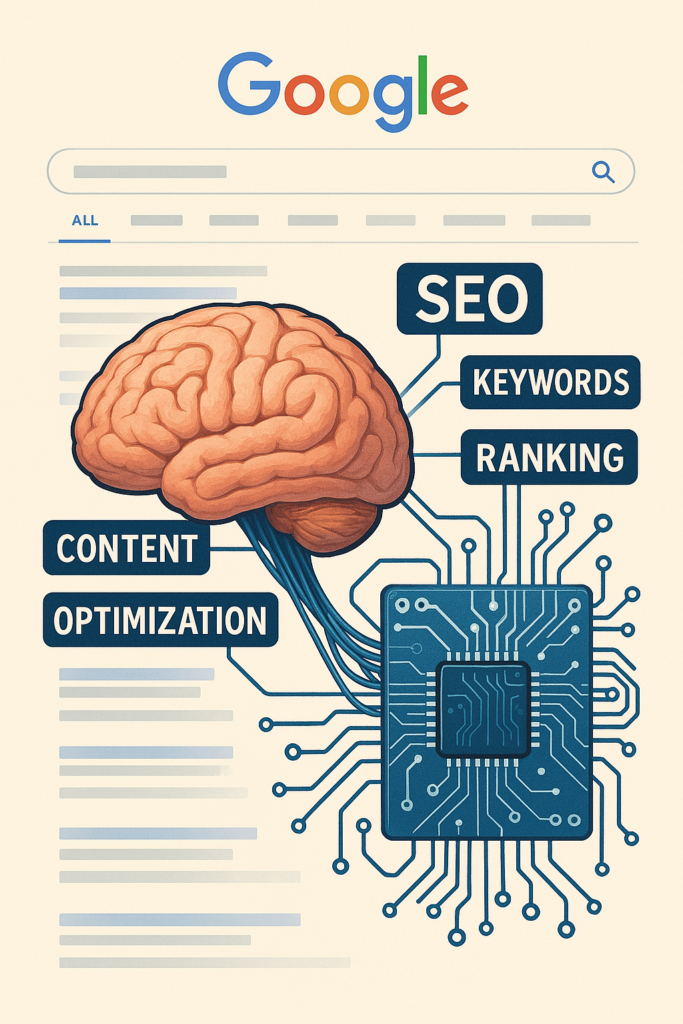
But let us dig a little deeper. These AI tools work by analysing millions of texts to understand writing patterns. Imagine a super-brain that had read every article on the web about your subject. It can:
- Generating text in any style
- Adapting the tone to your instructions
- Structure content automatically
- Offer endless variations on the same theme
The catch? This super-brain has no real experience. It simply combines what it has “read”, without really understanding. A bit like a very talented parrot.
Why are so many SMEs falling for AI?
I see 3 main reasons that appeal to my clients:
- Productivity: no more days spent writing, AI produces content in minutes. One of my clients multiplied their product page output by 5.
- Budget: no more paying writers (apparently…). When you see that an article can cost between CHF 150 and CHF 500, it is tempting
- Independence: no brief and no deadlines, you control everything. No more waiting for the writer's draft or managing rounds of back and forth
Start-ups are particularly fond of these tools. They can quickly build a content base without blowing their budget. I have seen a young company go from 0 to 100 articles in two weeks!
But all that glitters is not always gold…
The SEO traps of 100% AI content
Some of my clients learned this the hard way: letting an AI write without supervision is risky. Very risky, in fact. Let me tell you a few stories that make your blood run cold.
The painful example: an e-commerce site saw 30% of its pages deindexed after automating its product descriptions with AI without creating a specific profile. The result: 6 months of work went up in smoke in a few days.
Another real case: a business blog that lost 60% of its organic traffic after publishing 200 AI-generated articles without proofreading. The problem? Content that was:
- Too similar to each other (same structure, same sentences)
- Without real analytical depth
- Packed with generic information
- Sorely lacking concrete examples
- Sometimes even contradictory from one article to the next
Google is not fooled. Its algorithms are getting cleverer at spotting:
- Mass-generated content
- Texts with no real added value
- Articles that merely rephrase what already exists
- Inconsistencies in tone and style
And when Google spots that? Penalties. Deindexing. A drop in traffic. The SEO nightmare.
E-E-A-T: what Google really expects in 2025
In 2025, Google is betting everything on E-E-A-T (Experience, Expertise, Authority, Trust). It is their mantra for identifying quality content.
No mystery: human experience comes first. AI can help, but it does not replace:
- Your professional expertise forged over the years
- Your field feedback and concrete client cases
- Your unique tone reflecting your personality
- Your credibility built up over time
Google looks for tangible evidence of your expertise:
- Examples drawn from your experience
- Figures drawn from your own projects
- Testimonials from real clients
- Analyses based on real cases
I have noticed that sites that put their human experts forward (with detailed bios, authentic photos, regular contributions) perform markedly better than those that stay vague about their authors.
5 best practices for a winning AI-human mix
- Use AI for first drafts, never for the final text
Have it generate a working draft 2. Use several different prompts to vary the approaches 3. Keep what is relevant, throw out the rest 4. Reread EVERYTHING, correct EVERYTHING
Check every piece of information 5. Hunt down inconsistencies 6. Enrich with your own sources 7. Adapt the style to your brand 8. Inject your expertise and your concrete examples
Add your client case studies 9. Share your real figures 10. Illustrate with your successes and failures 11. Give advice drawn from your own experience 12. Keep a style consistent with your brand
Define a clear editorial charter 13. Keep the same tone across all your content 14. Use your own professional vocabulary 15. Stay true to your positioning 16. Sign your content, own where it comes from
Create detailed author profiles 17. Mention any use of AI 18. Stay transparent about your process 19. Start the conversation with your readers
Where can AI genuinely help you?
At my agency, we use AI to:
Brainstorming and research
- Generating original angles
- Explore related topics
- Identify frequently asked questions
- Spot emerging trends
Structure and organisation
- Creating detailed plans
- Suggest catchy headlines
- Suggest smooth transitions
- Organise the information logically
Content enrichment
- Developing certain points
- Adding generic examples
- Suggest alternative wordings
- Completing the technical sections
SEO optimisation
- Suggest relevant keywords
- Check the semantic density
- Generating meta descriptions
- Creating targeted FAQs
But always with meticulous human proofreading. At our agency, every piece of content passes through at least two pairs of eyes before publication.

So, is AI a friend or an enemy of SEO?
My view after hundreds of pieces of supervised content: AI is a great assistant, but a dangerous replacement.
The key? Keeping control. Using AI to gain efficiency, but not at the expense of quality. Here is my recipe for using it well:
- Define your objectives clearly before you begin
- Choose the right tools for your needs
- Set up a rigorous review process
- Train your teams in the responsible use of AI
- Measure your results regularly
- Adjust your strategy based on the feedback
Because in the end, it is your readers who judge. And they know the difference between generic content and content that genuinely speaks to them. I have seen bounce rates fall from 80% to 40% simply by re-humanising over-robotic content.
The best results? I see them with clients who use AI as one tool among others, not as a miracle solution.
Need help finding the right balance? Let us talk about it over a coffee ☕
Do you have questions about using AI in your content strategy? Leave a comment and I will be glad to answer with concrete points drawn from my experience!
👉 Access the pillar content “SEO & AI 2025” 👉 Or discover our “SEO for SMEs in 2025” support
PS: This article was written with my human expertise, enriched by AI, and carefully proofread before publication. Transparency matters!