It is Friday, 5.30 pm. Your marketing team is about to launch a new campaign for the French-speaking Swiss market. Suddenly, doubt sets in. Is the price on the spec sheet the right one? Is this the final version of the high-resolution visual? What follows is a frantic hunt through emails, shared folders and Slack messages.
For many company directors, this “friction” is seen as part of the job. They hesitate to invest in a new CRM (Customer Relationship Management) or a PIM (Product Information Management) for fear of breaking an already fragile productivity or facing massive internal resistance.
Yet the real danger lies here: every minute your marketing talent spends “cleaning up” Excel files or hunting down a missing piece of information is a minute stolen from your growth.
In 2026, hesitation is no longer a cautious option, it is a tax on your competitiveness. Moving to these tools is not a software update. It is a strategic re-education. It is about turning your teams from data caretakers into growth pilots.
PIM: from catalogue hell to the “Content Factory”
The PIM (Product Information Management) is often seen as a simple technical library. That is a fundamental mistake. For marketing, learning to work with a PIM means moving from manual craft to precision industry.
1. The end of the informational “witch hunt”
Before the PIM, product information is scattered: the R&D department has the specifications, sales has the discounted prices and marketing tries to fit it all into a brochure.
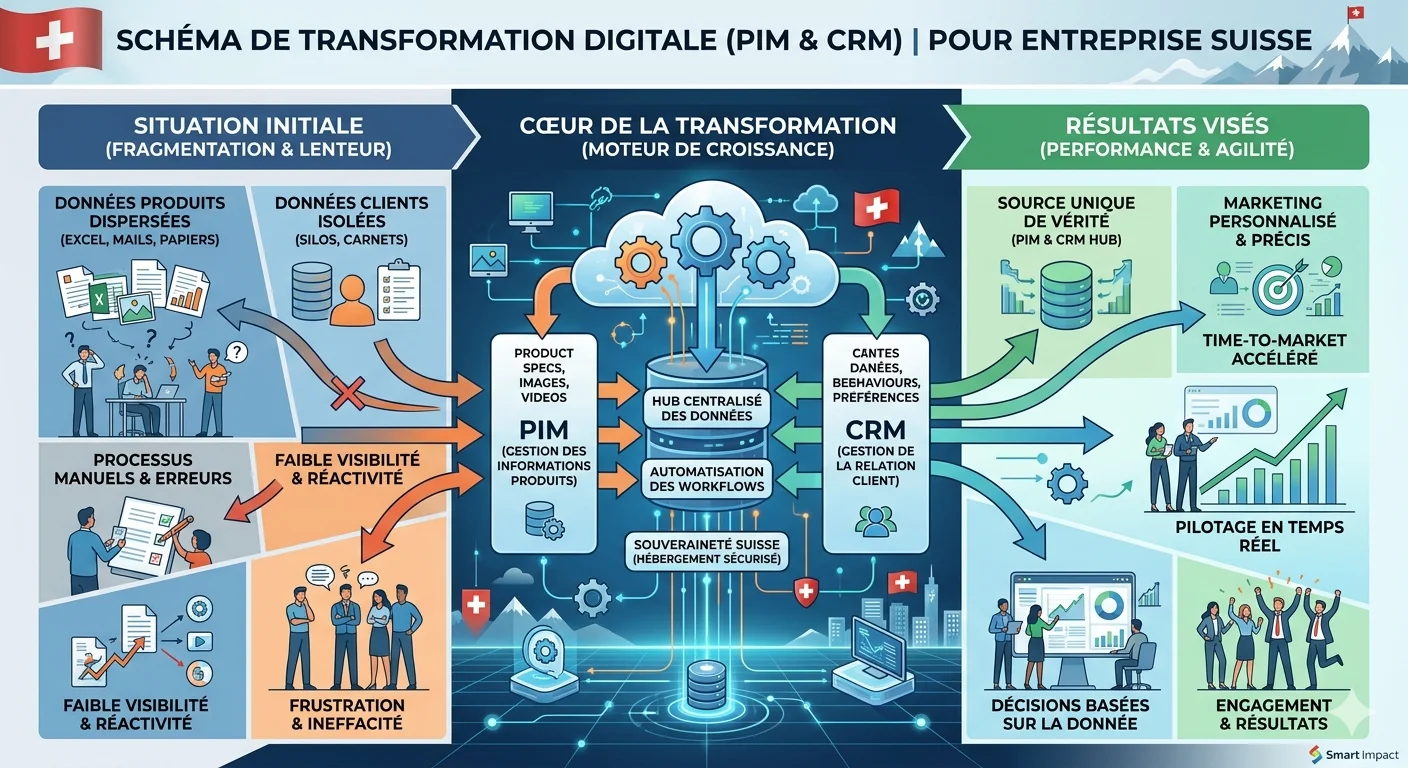
- The change: the PIM becomes the “single source of truth”. Your teams no longer look for the information, they * use* it.
2. From technical description to emotional branding
The hardest thing for a marketing team discovering a PIM is letting go of the technical data entry.
- The new mission: because the technical data (dimensions, weight, materials) is centralised and automated, marketing has to relearn its real added value: telling a story.
- The effect: instead of filling in boxes, your staff create buying experiences. They optimise SEO for French-speaking Switzerland, adapt the messages for the international market and look after the brand image.
3. Time-to-Market: your new speed lever
In an economy where speed of execution sets the rules, PIM turns your marketing into a Content Factory.
- Before: three weeks to produce a catalogue or update an e-commerce site.
- After: a few clicks to publish consistent information across every channel (web, print, marketplaces).
The director's analogy: imagine asking your builders to construct a house but making them mould every brick by hand before laying it. The PIM is the arrival of ready-made bricks on site. The house goes up faster, and it is stronger.
| Performance indicator | Before: the hell of Excel and silos | After: the power of PIM & CRM |
|---|---|---|
| Speed to market | 3 to 6 weeks (gathering information, corrections, approvals). | 48 hours (data ready and synchronised across every channel). |
| Data reliability | High in errors (outdated prices, out-of-date visuals). | 100% reliability (a single source of truth). |
| Client Experience | “Spray & Pray”: generic messages sent to everyone. | Hyper-personalisation: the right product at the right moment. |
| Team Productivity | 40% of time devoted to entering and cleaning files. | 90% of time devoted to strategy and to creating value. |
| Team morale | Frustration, the feeling of doing “robot work”. | Engagement: your talented people finally do the job they were hired for. |
| Executive visibility | Flying blind (fragmented and often late data). | Real-time dashboard: Decisions based on fresh data. |
TO READ: ERP & PIM: how these systems transform (and save) your company culture?
CRM: from simple address book to “crystal ball”
If the PIM manages what you sell, the CRM (Customer Relationship Management) manages who you sell it to. For a marketing team, relearning the CRM in 2026 means moving from administrative “monitoring” to “predicting” needs.
1. The end of harassment marketing
“Old-school” marketing bombards its database hoping that someone will take the bait. It is ineffective and it damages your brand image in Switzerland, where discretion and relevance are king.
The change: the CRM lets you segment your clients by how they actually behave.
The new skill: your teams have to relearn empathy at scale. Instead of writing a newsletter for 10,000 people, they configure workflows that trigger when a client expresses a specific need.
2. Marketing becomes sales’ best ally
The historic conflict between Marketing and Sales stops where the CRM begins.
The modern approach: marketing no longer hands sales “lists of names” but mature opportunities. Thanks to the CRM, marketing knows exactly when a prospect is ready to be called, because it has followed their whole digital journey.
3. Anticipating rather than reacting
A modern CRM, combined with a dose of AI, does not only tell you what happened last month. It tells you what may happen next month.
The transition: your marketing team moves from a “reporting” role (looking in the rear-view mirror) to a “forecasting” role (looking through the windscreen). It can anticipate a fall in demand or, conversely, a cross-selling opportunity before the client has even thought of it.
TO READ: 7 actionable SEO levers for French-speaking Swiss SMEs.
The leader’s role in this transition: sell the destination, not the vehicle
To succeed in this change, the CEO does not need to become an IT expert. Their role is to give meaning to rigour.
- Do not talk about “required fields”: talk about “knowing our clients better so we can serve them better”.
- Accept the “ugly middle”: every transition has a trough where the old system is dead and the new one is not yet smooth. That is where your emotional leadership comes in to hold the course.
- Invest in a culture of data: software costing CHF 50,000 is worth nothing if your teams have not understood that data is the most valuable asset your company has.
Speed is your new line of defence
You will have gathered that installing a PIM or a CRM is not an expense, it is buying your future agility. In the market of French-speaking Switzerland in 2026, the difference between the leader and the rest is no longer decided on the product alone, but on the ability to bring it to market faster and more intelligently than the others.
“Reskilling” your teams is therefore a necessary investment. It is time to turn your file managers into genuine growth architects.
Sources:
Gartner: reports on the “single source of truth” (SSOT). They explain how centralising data reduces operational errors by 20 to 30%.
Forrester: the concept of “Total Economic Impact” (TEI). Forrester often publishes studies showing the substantial return on investment of CRMs (such as Salesforce or HubSpot) over 3 years.
Harvard Business Review: “Digital Transformation Is Not About Technology“ (Tabrizi et al.).
MIT Sloan Management Review: their work on digital maturity explains why “mature” companies use PIM and CRM not to store data but to innovate.
The Federal Data Protection Commissioner (Préposé fédéral à la protection des données): for everything touching the Swiss Data Protection Act. Essential for the “sovereignty and security” aspect of your CRM.
ICTswitzerland / Digitalswitzerland: their annual reports on Switzerland's digital maturity let you place your client relative to local competitors.