Everyone wants more visitors. Unfortunately very few ask what becomes of those visitors once they arrive.
A site can have hundreds of clicks a day… and no clients at the end of the month. Not because the offer is poor. Not because the market is saturated. But simply because there is no client journey. Just a flow of attention lost in a maze with no exit.
An acquisition funnel is not a buzzword. It is a structure. A journey. A guide that turns a stranger into a prospect, then into a client.
A quick note on vocabulary (so as not to lose the thread)
This article talks about tunnels. Sometimes about funnels. Sometimes about both at once. And that can be confusing.
The word “funnel” comes from English. It refers to a funnel. It is the term used in most marketing tools, because it illustrates a simple model:
a large number of people come in at the top… and only a few come out at the end.
This model reflects a journey: plenty of curiosity at the start, few concrete decisions at the end. In French, the word “tunnel” is often preferred. It suggests less the idea of a funnel that sorts, and more that of a signposted path that guides you step by step.
That is why several expressions coexist in professional vocabulary:
- acquisition funnel: the journey that turns a stranger into a prospect
- sales funnel: the commercial extension aimed at the final conversion
- marketing funnel: the overall structure covering every stage
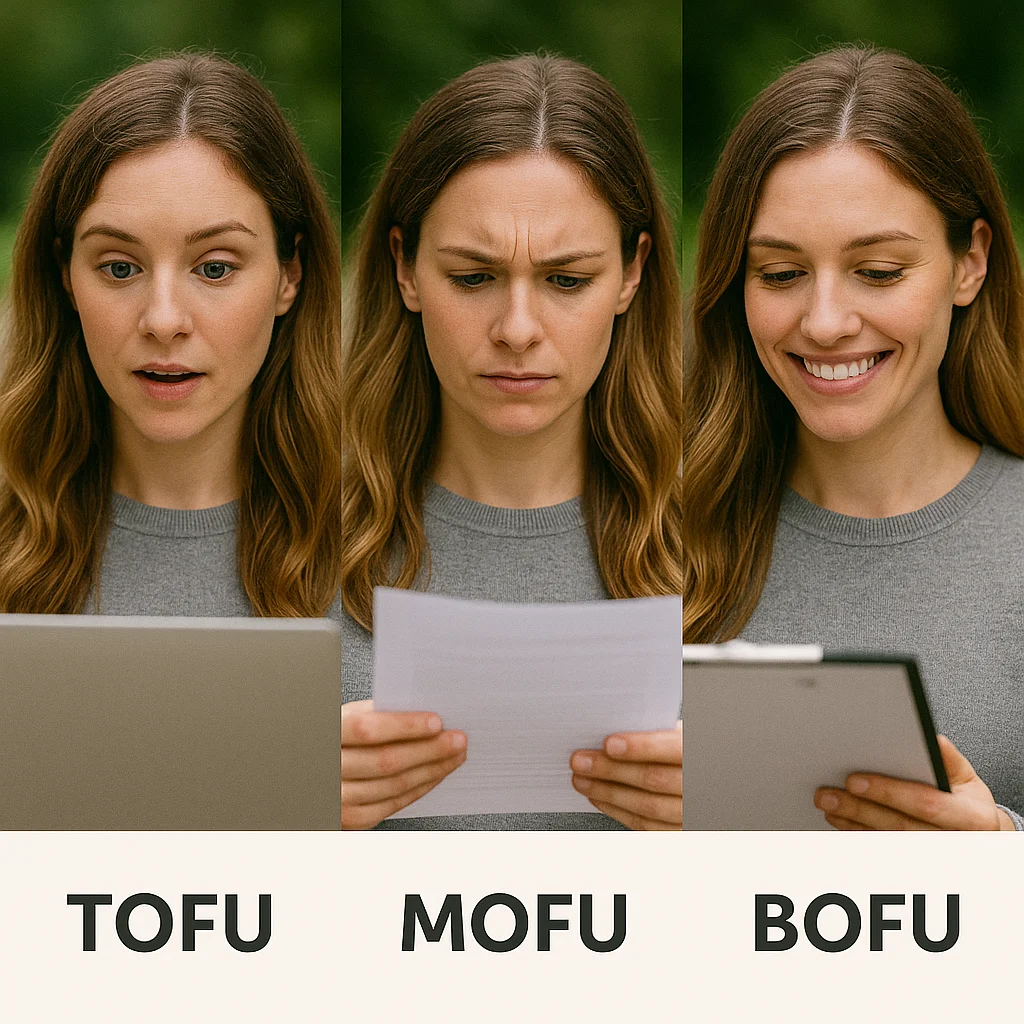
And in that vocabulary, three acronyms come up regularly: TOFU, MOFU and BOFU. English acronyms that are worth understanding in order to read a marketing article, report or tool properly.
TOFU stands for Top of the Funnel: the top of the funnel. This is the discovery phase. The aim is to attract attention, to bring a problem to the surface or to spark a first realisation.
MOFU stands for Middle of the Funnel. Here the prospect starts to take a solution more seriously. They compare, they read up. This is the moment to build a relationship and feed the connection.
BOFU stands for Bottom of the Funnel. This is the decision phase. The one where you propose a conversation, a piece of support, an offer. The moment of commercial truth.
Why this concept is often misunderstood
As soon as you say the word “funnel”, you can feel people tense up.
Some associate it with aggressive marketing. Others think it is something reserved for American startups or course sellers.
In fact, the funnel is nothing more than a logical path. A sequence of steps, designed to answer a simple question: how do you support a person, from their first visit through to the purchase decision?
Most sites have no funnel. They have pages. Articles. Buttons. But nothing tying it all together coherently.
Result:
- visits that lead nowhere,
- poorly qualified leads,
- marketing budgets that bring nothing back.
The 3 main stages of a real digital funnel
A good funnel follows a clear dynamic: attract → convert → convince.
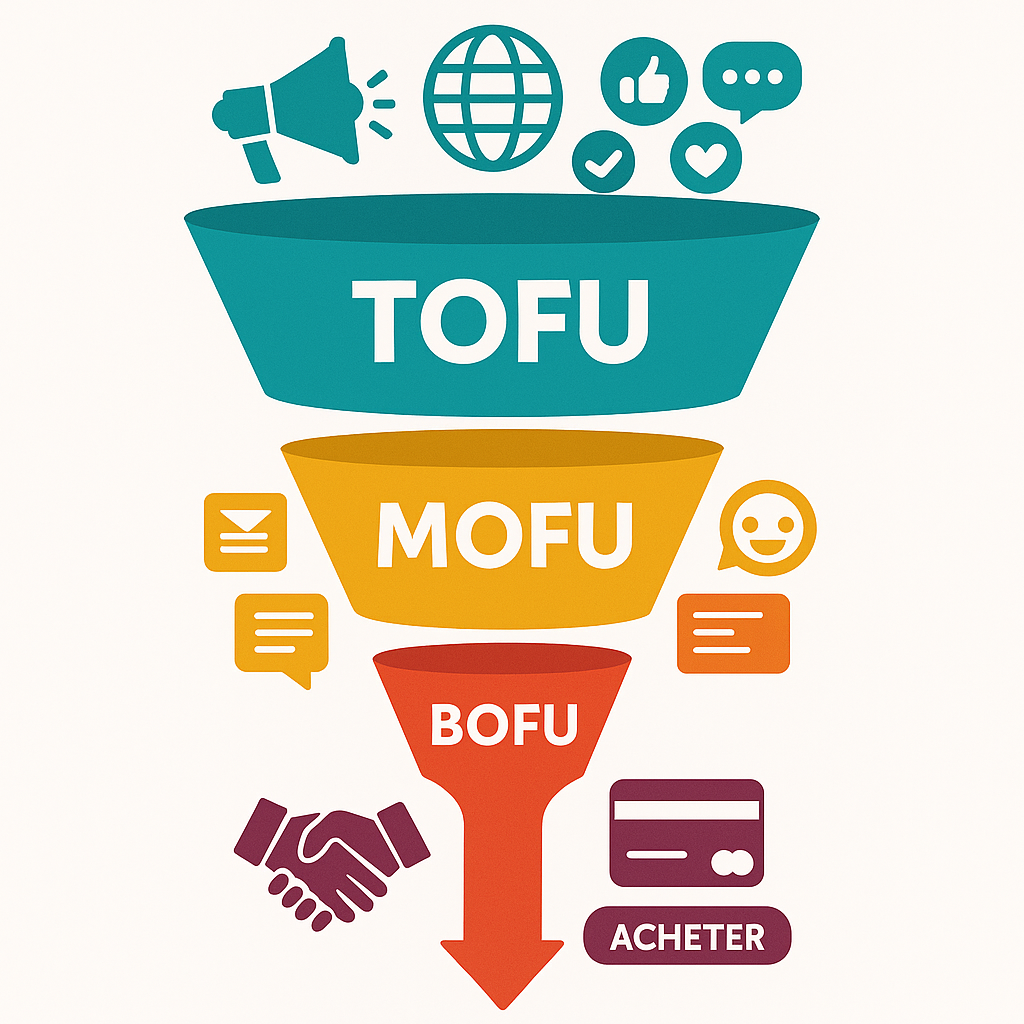
Attract (top of the funnel, TOFU)
That is where it all begins. Someone has to discover that the company exists. And think “interesting”.
The channels for attracting:
- search engines (SEO),
- advertising (SEA),
- social media,
- shared content.
So be careful: at this stage, the person is not yet looking to buy. They are informing themselves, exploring.
Example: a blog article titled “What are your rights after being dismissed?” or a LinkedIn post about a classic tax mistake. The aim here is not to sell. It is to create a first point of contact.
Convert (middle of the funnel, MOFU)
That is where the relationship starts to build.
The person has shown interest. They have clicked, read, watched. It is time to offer a next step. Something more committing.
This is the role of:
- lead magnets (PDF guides, checklists),
- sign-up forms,
- targeted newsletters,
- demonstrations, free trials.
Example: a lawyer offers a downloadable “checklist” for preparing a settlement agreement properly. That is not a sale. It is a chance to capture a qualified contact.
Convince (bottom of the funnel, BOFU)
Here, we are no longer talking to a stranger. We are talking to someone who knows who you are, what you do, and who is considering working with you.
Now is the time:
- reassuring (testimonials, case studies),
- adding value (personalised offers),
- guiding towards an action (a call, a quote, an appointment).
Example: a “Why choose us” page, clear, structured, with concrete proof. No hollow marketing. Substance.
Test it yourself:
Why measuring your acquisition funnel changes everything
Many talk about traffic. About engagement. About clicks.
But very few know what happens between a visitor arriving… and a contract being signed.
A site can generate a thousand visits a week and get no clients from it.
Not because it is badly made. Not because the offer is poor.
Because the funnel leaks. Because nobody measures what is lost along the way.
This small calculator lets you see your conversion rates at each stage at a glance.
Not to look good. To adjust, correct, and take back control.
Funnel conversion calculator
Step 1: Attraction Total number of visitors
Step 2: Engagement Number of leads or contacts collected
Step 3: Conversion Number of end customers
Overall conversion rate: -%
.conversion-container { max-width: 100%; width: 100%; max-width: 500px; margin: 40px auto; background: white; padding: 30px; border-radius: 10px; box-shadow: 0 4px 25px rgba(0,0,0,0.15); font-family: Arial, sans-serif; box-sizing: border-box; } .conversion-container input { width: 100%; padding: 10px; font-size: 16px; border: 1px solid #ccc; border-radius: 5px; box-sizing: border-box; } .conversion-result { background: #E9910B; color: white; text-align: center; padding: 20px; margin-top: 20px; border-radius: 8px; font-size: 20px; } .step-title { margin-top: 30px; font-size: 18px; color: #444; border-bottom: 1px solid #ddd; padding-bottom: 5px; } @media screen and (max-width: 600px) { .conversion-container { padding: 20px; } .conversion-result { font-size: 18px; } }
function updateRate() { const top = parseFloat(document.getElementById(“top”).value); const middle = parseFloat(document.getElementById(“middle”).value); const bottom = parseFloat(document.getElementById(“bottom”).value); const output = document.getElementById(“output”);
if (!isNaN(top) && !isNaN(middle) && !isNaN(bottom) && top > 0 && middle > 0) { const step1 = (middle / top) * 100; const step2 = (bottom / middle) * 100; const overall = (bottom / top) * 100;
output.innerHTML = “Stage 1 rate (Visitors > Leads): “ + step1.toFixed(1) + “% “ + “Stage 2 rate (Leads > Clients): “ + step2.toFixed(1) + “% “ + “Overall conversion rate: “ + overall.toFixed(1) + “%”; } else { output.innerHTML = “Overall conversion rate: –%”; } }
document.addEventListener(“DOMContentLoaded”, function () { document.querySelectorAll(“#top, #middle, #bottom”).forEach(input => { input.addEventListener(“input”, updateRate); }); });
What a well-designed funnel really changes
When everything is aligned, the results change. There is no need to double the traffic. It is enough to double the logic.
This small calculator lets you see your conversion rates at each stage at a glance. Not to look good. To adjust, correct, and take back control.
- reduces the bounce rate,
- helps increase the number of qualified leads,
- lowers the acquisition cost,
- and finally gives marketing activity a direction.
It is a framework, not a factory. And it is often that framework that “pretty but empty” sites lack.
The classic mistakes you see everywhere
- Trying to sell from the very first click. Nobody buys at first glance.
- Forgetting the intermediate steps. You go from “hello” to “pay me”.
- Not segmenting the messages. The same message for everyone no longer works.
- Leaving leaks everywhere. Too many links, too many distractions, no clear path.
A funnel must not shut people in. It must guide them.
What to take away
A site can be beautiful. An offer can be clear. But without a funnel, the prospect goes round in circles. They read. They click. They hesitate. Then they leave.
The acquisition funnel is not a hack. It is a way of taking visitors by the hand, without ever forcing them, and leading them naturally towards conversion.
And often, that small structured path makes all the difference between a website that ticks over and a website that sells.
📊 Studies and benchmarks on conversion rates
- First Page Sage – Conversion benchmarks for B2B SaaS funnels A detailed report giving average conversion rates at each stage of the funnel for B2B SaaS companies, segmented by marketing channel, industry and company size.👉 Read the reportfirstpagesage.com
- Mosaic – Analysis of conversion rates in sales funnels A guide explaining how to measure and improve conversion rates at every stage of the funnel, with advice on identifying friction points and improving overall effectiveness.👉 Read the article