

B2B marketing in Switzerland traditionally rests on solid pillars: expertise, trust, and the quality of human relationships. Yet the era of Artificial Intelligence (AI) is redefining the way these relationships are initiated and maintained. Far from being a gadget or a threat, AI is now seen as an essential lever for moving from mass marketing to an approach built on hyper-precision. Crucial in a market as demanding as the Swiss one.
The challenge for Swiss companies is not only to adopt AI. It is to integrate it while respecting the strict requirements of data protection (LPD, the Swiss Data Protection Act, and GDPR) and while strengthening human expertise (E-E-A-T). AI is there to augment the marketer, not to replace them.
These figures matter to any leader looking to secure a competitive edge. Discover the 15 essential statistics to justify your investments, refine your lead generation and make AI the engine of your B2B growth in 2026.
Where does the Swiss B2B market stand on AI?
Switzerland, an engine of innovation, shows a high level of maturity in digital transformation. The following statistics illustrate the level of AI adoption in B2B marketing processes and how budgets are evolving.
1️⃣ Percentage of B2B companies that have launched an AI POC
- Key figure: around 65% of large and medium-sized Swiss B2B companies have already launched at least one proof of concept bringing AI into their marketing or sales processes.
- Strategic implication: AI has moved from experiment to competitive standard. Not testing means falling behind.
2️⃣ B2B sectors leading adoption
- Key figure: the finance/insurance and pharma/tech sectors show an AI adoption rate above 75% for predictive risk analysis and lead qualification.
- Strategic implication: these heavily regulated sectors prove that AI can be brought in even in sensitive environments. Provided data governance is respected.
3️⃣ Annual growth rate of AI MarTech spending
- Key figure: Swiss companies' spending on AI-based MarTech tools is growing by an average of +18% a year.
- Strategic implication: the market has validated the effectiveness of AI solutions. The investment is durable and no longer limited to stand-alone tools.
4️⃣ Share of marketing budgets allocated to AI personalisation
- Key figure: B2B market leaders now allocate on average 10% to 15% of their marketing budget to hyper-personalisation and to AI-supported Account-Based Marketing (ABM) campaigns.
- Strategic implication: personalisation is no longer a luxury. It is an essential budget line, because it directly improves the quality of the leads passed to sales.
The impact of AI on the B2B conversion funnel
AI does not merely automate. It introduces predictive intelligence that can significantly raise the quality and velocity of leads. And it does so throughout the conversion funnel.
5️⃣ Increase in the lead qualification rate (SQL)
- Key figure: using AI models for predictive lead scoring (based on engagement, history and company size) leads to an increase of up to 30% in the conversion rate from MQL to SQL (Sales Qualified Leads).
- Strategic implication: AI lets the sales team concentrate its resources on the prospects with the highest probability of converting. That improves sales and marketing alignment.
6️⃣ Reduction in time spent on initial content
- Key figure: Swiss B2B marketers using generative AI tools for blog article drafts, case study summaries or email subject lines report an average productivity gain of 40% to 50% on initial content writing tasks.
- Strategic implication: this time saved has to be reinvested in validating human expertise and strengthening E-E-A-T (Statistic 10). AI handles the quantity, the human guarantees the quality.
7️⃣ Improvement in the relevance score of ABM campaigns
- Key figure: Account-Based Marketing (ABM) campaigns supported by AI to identify buying signals and personalise messages achieve a relevance and engagement score 2.5 times higher than conventional ABM campaigns.
- Strategic implication: AI makes it possible to target decision-makers at strategic accounts surgically. The result: you maximise impact in the B2B sales cycle, which is often long and complex.
8️⃣ Reduction in organic cost per lead (CPL)
- Key figure: intelligent SEO automation (bid optimisation, keyword identification) and predictive analysis can reduce the overall cost per lead (CPL) obtained through paid channels by 15% to 25%.
- Strategic implication: by better predicting the most profitable audiences, AI makes budget allocation more effective and reduces waste.
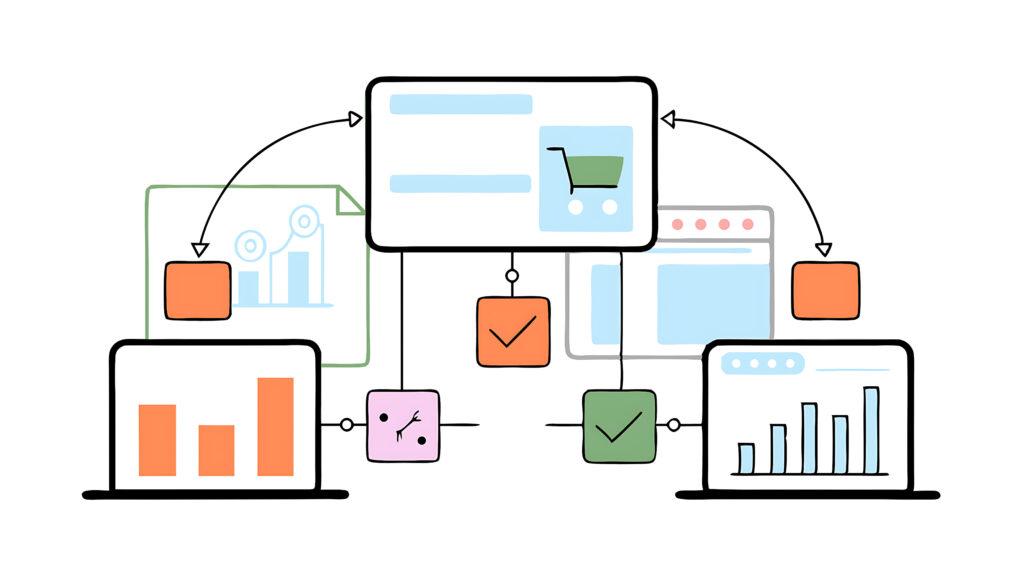
Personalisation and customer experience statistics
AI enables B2B marketers to go beyond simple segmentation and reach hyper-personalisation, where the content, the moment and the channel are adapted to the decision-maker’s individual profile.
9️⃣ Increase in the open rate of B2B emails personalised by AI
- Key figure: B2B email campaigns using AI to optimise the subject line (predicting the most engaging subject) and the send time show an increase in open rate of the order of 25% to 40%.
- Strategic implication: AI solves “email fatigue”. It makes sure the message reaches the decision-maker at the moment they are most likely to read it. The effectiveness of prospecting improves as a result.
🔟 Improvement in customer satisfaction (CSAT) through AI assistance
- Key figure: bringing in conversational AI chatbots for immediate answers to technical or administrative B2B questions leads to an improvement in customer satisfaction (CSAT) of up to 15%.
- Strategic implication: AI takes on the “low-level” queries. That frees human experts for the high-value interactions that strengthen the client relationship.
1️⃣1️⃣ The hyper-personalisation criterion in B2B decision-making
- Key figure: close to 60% of Swiss B2B decision-makers say that hyper-personalisation and the relevance of the content they receive are significant criteria in how they evaluate and finally choose a supplier.
- Strategic implication: B2B is increasingly emotional and personalised. Your content must not only be accurate, it has to be personally relevant.
1️⃣2️⃣ Success rate of AI recommendations
- Key figure: AI recommendation systems (suggesting additional services or products based on purchase or usage history) show a success rate for cross-sell and * up-sell* of up to 35%.
- Strategic implication: AI is an excellent engine for maximising customer lifetime value (CLV) and identifying opportunities for incremental growth.

Statistics on challenges and future trends (Swiss specifics)
AI adoption in Switzerland is tempered by strict requirements around Trust and competence. These figures anticipate the barriers to remove in order to secure the investment.
1️⃣3️⃣ Data protection as the main barrier to adoption
- Key figure: more than 70% of Swiss B2B companies cite data protection (GDPR and the revised Swiss act) as the main obstacle to broader and faster AI adoption.
- Strategic implication: investment has to focus on on-premise solutions or AI platforms that guarantee data sovereignty and legal compliance. Trust runs through the technical choices.
1️⃣4️⃣ Salary gap for “AI Marketing Specialist” roles
- Key figure: “AI Marketing Specialist” or “Marketing Data Scientist” roles show an average salary gap of +20% to +35% compared with traditional MarTech roles in Switzerland.
- Strategic implication: AI skills are rare and expensive. Companies have to invest in internal training to close the skills gap.
1️⃣5️⃣ Projected Sales-Marketing synergy through AI
- Key figure: the synergy (smarketing) between sales and marketing teams, fed by shared AI tools (lead scoring and prediction), is forecast to increase pipeline effectiveness by 15% to 25%.
- Strategic implication: AI is the technological bridge that finally unites the objectives of sales and marketing. It has to make sure both teams are working on the same priority leads.
Further reading in the same series
- GEO/SEO statistics in Switzerland: how search is changing in the Swiss market.
- Top 20 SEO statistics: the overall picture of search optimisation.
Would you like to bring AI into your acquisition without neglecting SEO? Discover our approach to SEO in the AI era.
AI is not a choice, it is a competitiveness factor
The era of Artificial Intelligence marks the transition of B2B marketing in Switzerland towards hyper-precision. These fifteen key figures confirm it. AI is no longer an experiment. It is an essential competitiveness factor for lead generation, cost optimisation and maintaining high-quality customer relationships.
B2B excellence in 2026 will be achieved by those who manage to integrate AI while respecting the Swiss imperative of trust and data protection.
Our closing conviction: use these 15 statistics to justify your investment roadmap. Concentrate on data governance and secure the future of your growth pipeline.
💡Discover Smart Impact’s services
Sources:
The statistics and analyses presented in this article for the 2025 horizon are based on the consolidation of data from the following reference reports and on expert extrapolations:
- ZHAW School of Management and Law (Swiss Marketing Leadership Study): the data on AI adoption (Stat. 1) and marketing budgets (Stat. 4) draw on the trends observed in this annual benchmark study among Swiss decision-makers.
- Deloitte Switzerland (Digital Maturity Reports): the figures on the leading sectors (Stat. 2) and the barriers linked to data protection (Stat. 13) are corroborated by Deloitte's digital maturity analyses of the Swiss market.
- Salesforce (State of Marketing – EMEA/Switzerland focus): the performance metrics, particularly on personalisation (Stat. 9) and Sales-Marketing alignment (Stat. 15), are drawn from global and regional benchmarks on the use of CRM and MarTech tools.
- McKinsey & Company (The Value of AI): the estimates on economic impact, cost reduction (Stat. 8) and the importance of hyper-personalisation (Stat. 11) come from McKinsey's economic modelling applied to the B2B sector.
- Swiss job market analyses (Michael Page / LinkedIn Economic Graph): the data on salary gaps (Stat. 14) and demand for AI skills reflects the current tension seen on Swiss recruitment platforms.